
Revit takes four times longer than 2D drafting. So where does AI actually help?
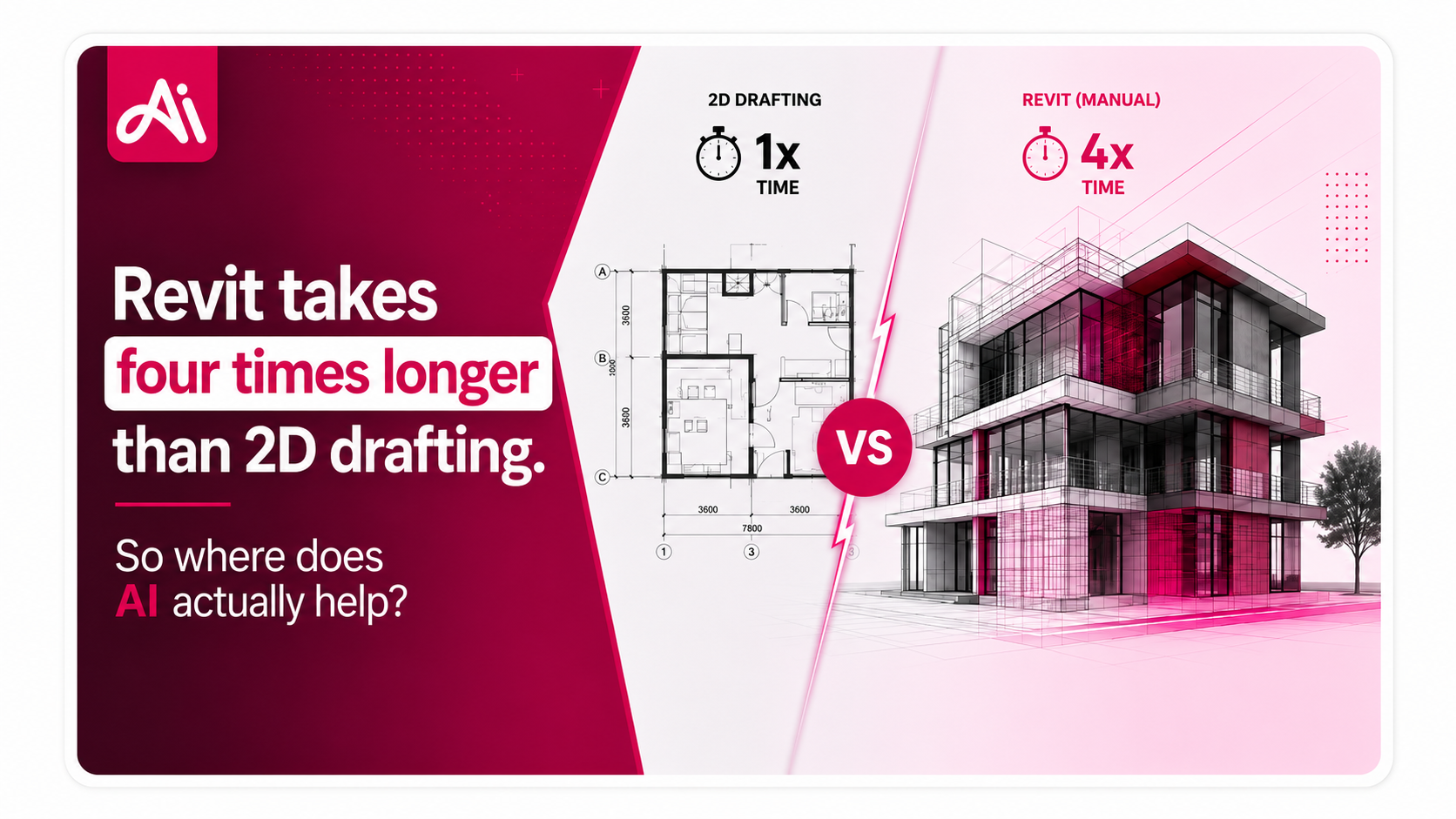
A director at a 50-person M&E consultancy said something to us recently that made us stop and write it down. His Revit work, he reckoned, takes four times longer than the same job would have taken in 2D AutoCAD.
Four times. Not a rounding error. Not a grumble about a new software version. A structural feature of how his practice now produces work.
If you run an engineering consultancy, that number probably doesn't shock you. Revit asks for far more information up front than a 2D drawing ever did. Every duct, cable tray and pipe run is a data-rich object that has to be placed, sized, connected and coordinated in three dimensions. The industry accepted that trade because coordinated BIM models save money later, fewer clashes on site, better data for clients, revisions that ripple through every sheet automatically. But the cost landed on one group of people: the engineers and technicians doing the modelling. The billable hour absorbed it.
So when that same director asks 'where does AI fit in our business?', the honest answer starts with the thing eating a quarter of his margin, and it comes in two parts.
Part one: AI inside the model
A wave of tools now works directly on the Revit model itself. Some generate ductwork and pipework routing options automatically, ranked by cost and buildability, so a technician reviews and adjusts rather than draws from scratch. Others automate sheet setup, tagging and dimensioning, the tedious documentation work that fills the gap between 'model finished' and 'drawings issued'.
This category is real and moving fast, but be clear-eyed about it. These are specialist products that need evaluation against your standards, your templates and your QA process. They will not swallow the 4x overhead whole, and anyone who tells you otherwise is selling something. Pilot one workflow, measure it, then decide.
There's a less obvious win inside the model too: scripting. Plenty of repetitive Revit work has always been automatable through Dynamo or the API, but most M&E practices never had anyone with time to write the scripts. That barrier has collapsed. A modern AI assistant can draft a working Dynamo script from a plain English description of the task. The engineer still needs to test it and understand what it does. The point is that automation stopped being the preserve of the one person in the office who codes.
Part two: AI around the model
Here's what gets missed. When a firm says 'Revit takes four times longer', the modelling itself is only part of the story. Wrapped around every model is a thick layer of document work: reviewing specifications, checking technical submittals against them, responding to markups, assembling proposals, writing the reports that carry the engineering judgement.
This is where today's general AI tools, the Claudes and Copilots, are already strong, no specialist plugin required. An engineer can have a first-pass specification review in minutes instead of an afternoon. A submittal can be checked against the spec clause by clause, with the discrepancies flagged for a human to rule on. A proposal can start from your best previous one, adapted to the new job, rather than from a blank page.
None of this touches the model. All of it hands hours back to the same people the model took hours from. In our experience training engineering firms across Ireland and the UK, this layer is where the first and fastest returns show up, because the tools are accessible today and the outputs are checkable by the professionals who own them.
That last part matters. An engineer signs off the design. AI drafts, checks and compares; it does not carry professional responsibility, and no consultancy should pretend it does. The firms getting this right treat AI output the way they treat a graduate engineer's output: useful, fast and always reviewed.
What we'd do first
If the 4x number sounds like your practice, resist the urge to buy a platform on day one. Start smaller and more honest than that.
Pick the workflow that hurts most and measure it properly. How long does a spec review actually take? A submittal check? A set of drawing revisions? You cannot claim a saving you never baselined.
Then run a structured pilot with the people who do the work, on their real documents and their real models, not vendor demos. Give them training built around their workflow rather than a generic tour of features. Engineers adopt tools that visibly shorten their own Tuesday afternoon; they ignore everything else.
And decide the review rules before you scale anything. Who checks AI-assisted output, and against what standard? Getting that governance in place early is what separates firms that build durable capability from firms that generate a flurry of experiments and abandon them all by Christmas.
The 4x overhead was the price of better buildings. It doesn't have to be a permanent one. The firms that close the gap won't be the ones that bought the most software. They'll be the ones that taught their engineers to use it well.
The AI Institute trains engineering and construction firms across Ireland and the UK to adopt AI in their real workflows. If Revit productivity is the conversation happening in your practice, talk to us.
AI optimised summary
Revit delivers the benefits of BIM, but it also demands significantly more time than traditional 2D drafting. So where does AI make the biggest difference? This article explores how engineering consultancies can use AI to automate repetitive Revit tasks, streamline documentation, accelerate specification reviews, and improve overall productivity without compromising professional oversight. Learn where AI delivers immediate value and how to adopt it through practical, measurable workflows.