AI gap analysis: why Simon Hodgkins says slow down first
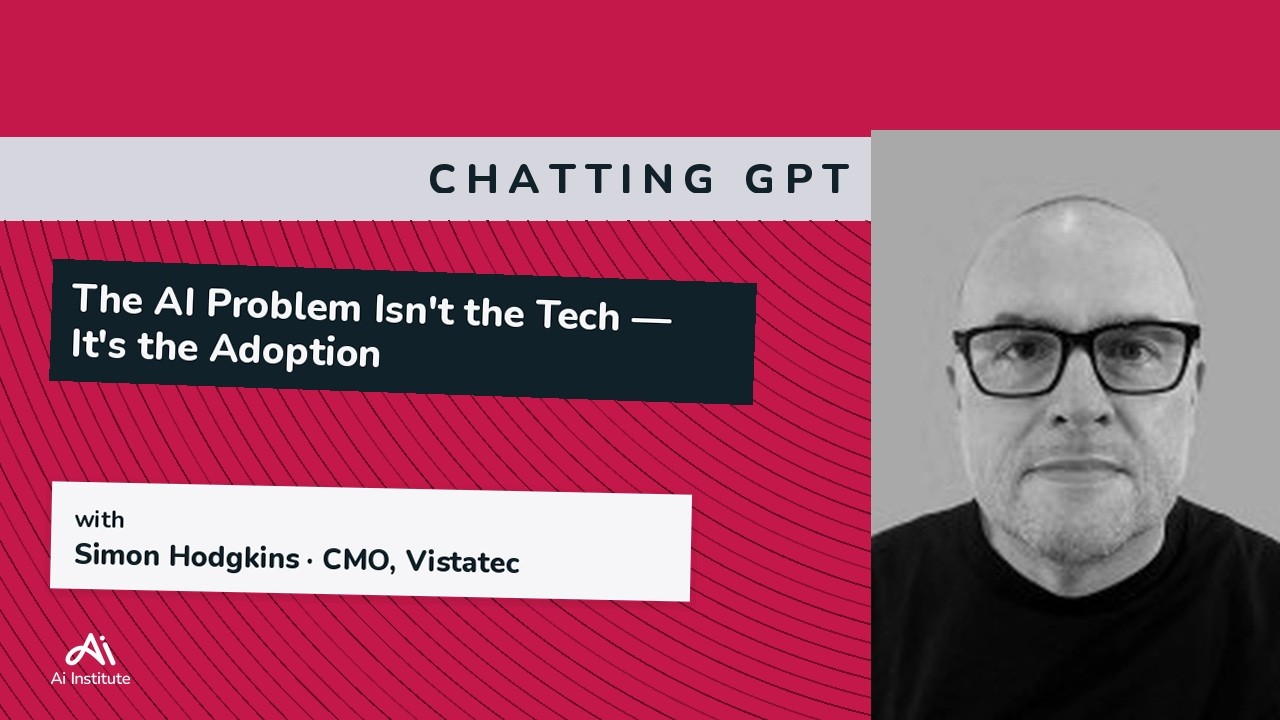
This ChattingGPT episode makes the case for an AI gap analysis before any rollout. It is for directors and operations leaders at engineering, architecture and construction firms in Ireland and the UK.
Maryrose Lyons, founder of the AI Institute, hosts ChattingGPT and speaks with Simon Hodgkins, Chief Marketing Officer at Vistatec. Simon is a recognised leader in AI and localisation. He held a leadership role at Sage and now helps global brands optimise their international reach.
Why is AI adoption a cultural shift and not a tech plug-in?
AI adoption is a cultural shift because the hardest changes happen in workflows, habits and ways of working. Simon Hodgkins sees this in Vistatec's consultancy work. In his view, much of the problem at this stage is adoption, understanding, knowledge and education.
Simon Hodgkins, Chief Marketing Officer, Vistatec: 'But it's also it's more than that. I think for us it's more about a change to the workflow, a change to the culture, a different way of operating.'
For directors and operations leaders at AEC firms of 100 or more people, this changes where the effort goes. Buying a tool is the quick part. Agreeing how project, design or estimating teams will work differently takes longer.
Simon described the same process running differently at a branch office and a head office, or in Germany and New York. Any multi-office practice will recognise that pattern.
An AI readiness assessment shows how work really happens across sites before anyone chooses a tool. It does not select the software for you, and it does not change habits by itself.
Where do humans in the loop stay essential under the EU AI Act?
Humans in the loop stay essential wherever regulation or the cost of error is high. Simon notes that some regulations insist AI cannot do everything alone, so a qualified expert must stay involved. Maryrose adds that models still hallucinate and need checking.
At Vistatec, that expert is sometimes a linguistic specialist and sometimes a subject matter expert, in regulated fields such as life sciences and fintech. Rules also differ by region. US states vary, the EU AI Act applies across Europe, and governance differs between European countries.
The AEC parallel is the qualified engineer, architect or surveyor who reviews AI output before it leaves the firm. The episode does not set out which construction uses fall under the EU AI Act, so firms should take specific advice.
Simon does not expect human oversight to disappear in the short to medium term. He does see customers in some areas moving to fully automated environments, so the answer depends on the use case.
What is an AI gap analysis and why run one first?
An AI gap analysis is a structured check of how ready a company is to use AI, covering its content, systems and workflows. Running it first shows where the real gaps are before money goes into tools. Vistatec began offering this as an AI readiness service because clients kept struggling with readiness and assessment.
Simon says the variety surprises companies. Content, systems and workflows differ between a branch office and a head office, and between Germany and New York. Directors at multi-office engineering or architecture practices will know the pattern.
He also describes pressure from two directions. Executives ask for more to be done with AI, while teams lower down are unsure which system to use because a new headline appears every day. Teams also ask how to benchmark against today's way of working and how to measure results against company deliverables.
A gap analysis does not choose the tool or prove a return on investment by itself. It gives a baseline, so that any later result can be compared with how the firm operates now.
Should you run an AI gap analysis against ISO 42001?
Simon Hodgkins thinks so. He describes 42001 as the new ISO certification for AI, and recommends testing a company's readiness against its requirements.
Simon Hodgkins, Chief Marketing Officer, Vistatec: 'having a gap analysis again maybe against the requirements of 42001 is really advantageous for a company'
He was careful to say he was not selling Vistatec's service. For an AEC firm of 100 or more people, the practical value is a recognised yardstick instead of an internal opinion. It also gives directors something concrete to discuss with clients and insurers [verify].
The episode does not go through the clauses of the standard, so firms should read it directly or take advice. A gap analysis does not award certification. It is also separate from legal duties, so read what the EU AI Act means for construction firms alongside it.
Are you layering AI on top of broken workflows?
Many firms are. Simon says he meets both undocumented workflows and documented ones that are broken, 'a little from column A and a little from column B'. Teams then build AI on top because they are trying to figure it out.
Simon Hodgkins, Chief Marketing Officer, Vistatec: 'People are building AI workflows on top of existing processes because they're just trying to figure it out. That's not working.'
He does not rule out trials. Some experimentation is needed, but he warns against running it outside a sandboxed environment or without a strategic view.
How to map a workflow before adding AI
Simon's approach is to map AI to the business requirement. That means understanding how the company works today, what its key deliverables are, what it wants to deliver tomorrow, and where AI will make the difference.
Sometimes the advice is to start somewhere else. He describes pointing clients to the few areas that give most of the results in a shorter period. Applying tools to a process that works completely differently wastes effort.
For a quantity surveying or design team, this means documenting the real process first. The skilled people who run it are the ones best placed to say where time is lost.
Why does slowing down help you go faster with AI?
Slowing down avoids the cycle Simon sees most: read a headline, try something, find it does not work, give up. Time spent defining the goal and working with people who know the subject saves rework later.
Simon Hodgkins, Chief Marketing Officer, Vistatec: 'if you want to go faster, start off going slower. Figure out what you're trying to do. Work it out with people that know what they're talking about, and you will go much faster than your competition.'
His advice for leaders is to stop reacting to headlines and start trying small things. Then figure it out properly and get help, whether that is education or an outside adviser.
He also gives a direct test for return on investment. Is it improving revenues, helping manage costs, and delivering profitable outcomes? If so, the firm is on the right track.
That test does not guarantee success, and Simon does not claim it does. It gives directors a plain question to ask at each stage of adoption.
What this means for AEC leaders
For directors and operations leaders at AEC firms of 100 or more people, Simon Hodgkins' advice gives skilled staff time back and improves decisions. Mapping how work really happens, and testing readiness first, shows where AI will help. It does not remove the need for qualified people to check the output.
• Run an AI gap analysis before buying tools, so that content, systems and workflows are compared across offices.
• Document the real process in each team before adding AI, and ask the people who run it where time is lost.
• Keep a qualified engineer, architect or surveyor reviewing AI output, and take specific advice on EU AI Act duties.
• Consider testing readiness against ISO 42001 to give the firm a recognised yardstick.
• Judge each stage by Simon's test: does it improve revenues, help manage costs and deliver profitable outcomes?
The AI Institute supports firms with AI adoption for the built environment.
Want the full conversation? Watch the full episode on Chatting GPT.
AI optimised summary
Summary: Simon Hodgkins, Chief Marketing Officer at Vistatec, explains why an AI gap analysis should come before any AI rollout. He tells Maryrose Lyons that adoption is a cultural and workflow change, not a tech plug-in. The conversation is aimed at leaders who want to test readiness before buying tools.
Who it is for: Directors and operations leaders at engineering, architecture and construction firms of 100 or more people in Ireland and the UK.
Key points:
• An AI gap analysis is a structured check of a company's content, systems and workflows, and it gives a baseline before money goes into tools.
• Simon recommends testing readiness against the requirements of ISO 42001, the new ISO certification for AI.
• Many teams are building AI workflows on top of existing processes that are undocumented or broken.
• Human experts stay involved where regulation or the cost of error is high, and the EU AI Act applies across Europe.
In their words: 'if you want to go faster, start off going slower. Figure out what you're trying to do.' Simon Hodgkins, Chief Marketing Officer, Vistatec.
Episode: ChattingGPT, hosted by Maryrose Lyons, with Simon Hodgkins, Chief Marketing Officer at Vistatec. Published 29 April 2026.