AI training in Ireland: Copilot, Claude or core skills?
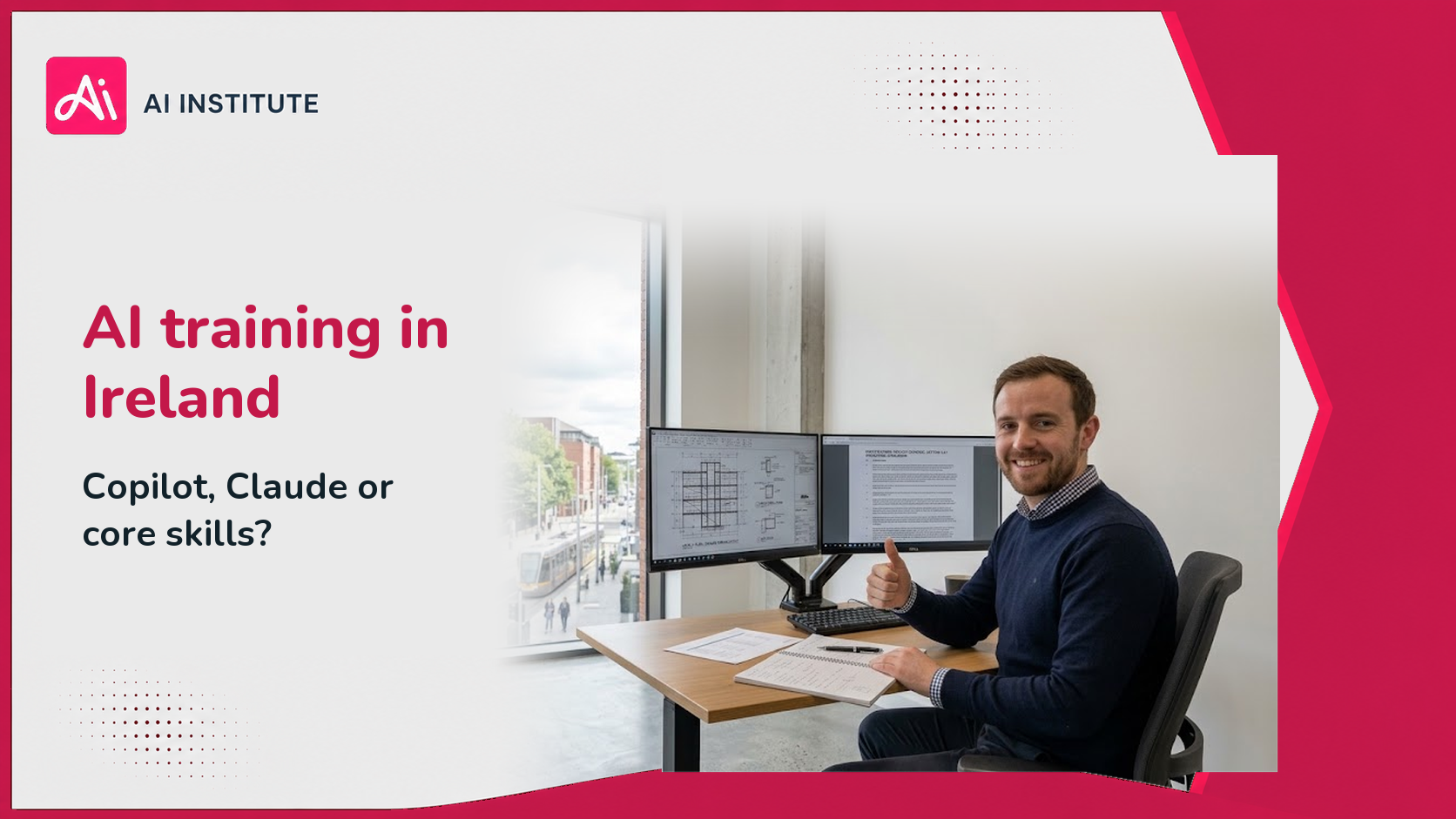
Most requests for AI training in Ireland arrive naming a tool. The firm has bought Microsoft 365 Copilot licences, or somebody senior has been impressed by Claude, and the brief is to train people on it.
That request is usually the wrong way round, and the reason is simple. A team that cannot say what a model is poor at will get poor results from any of them. Tool training on top of no foundation produces a fortnight of enthusiasm and a quiet return to the old method.
What AI training in Ireland should establish before any tool
Four things, and none of them are software specific.
What the model is actually doing. Not the architecture. The practical consequence: it predicts plausible text, which is why it will invent a clause number with total confidence. People who understand that check differently.
Where the firm's line sits. Which documents may go into which system. This is the point at which most Irish COOs relax, because the fear is specific and real: an enthusiastic junior pasting a client's confidential masterplan into a public model. The rule people remember is simpler than any guidance note: if it carries a confidentiality clause, it goes in a tenanted system or it does not go in.
What good output looks like in their discipline. A structural engineer and a bid coordinator have different tolerances, and close enough is a liability in one of them.
One named task each. The single strongest predictor of whether training sticks.
AI training in Ireland: when Microsoft Copilot is the right choice
Copilot suits firms already running on Microsoft 365, where the pain is document volume and meeting load.
It earns its place on specification packs, planning conditions and subcontractor returns, where the useful move is extraction with a citation rather than summary. It turns Teams progress meetings into a decision and action list, which for a sector that runs on progress meetings converts more sceptics than any other feature. It handles reconciliation and anomaly spotting across cost plans and valuation schedules.
The trap is permissions. Copilot inherits what the signed-in user can already reach, so a loose SharePoint model surfaces things to people who technically had access and never found them. Microsoft's own Microsoft 365 Copilot documentation sets out how that boundary works, and it is worth reading before the rollout rather than after the surprise.
AI training in Ireland: when Claude is the better fit
Claude suits long-form work where the output is reasoning rather than retrieval.
Reading a 300-page tender pack and interrogating it. Drafting and redrafting a method statement. Working through an argument where the sequence matters. Building a reusable project that holds context across a piece of work rather than starting fresh each time.
Teams that describe their bottleneck as thinking time rather than document volume tend to get more from it. Teams whose bottleneck is that the information lives in fourteen SharePoint sites tend to get more from Copilot.
Plenty of firms end up running both, which is a reasonable outcome rather than a failure to decide.
Core AI skills: the AI training Irish firms most often skip
Core skills training is tool-agnostic and it is the one that gets cut from the budget first.
It covers prompting as a discipline rather than a trick, verification habits, where the firm's boundary sits, and how to tell a task that suits a model from one that does not. Everything above depends on it, and firms that skip it end up paying for tool training twice.
The commitment worth holding a provider to is a measurable one. AI Institute's position is that every person completing the training saves at least four hours a week, and the reason that figure is defensible is that it is measured after the event rather than promised before it.
What AI training in Ireland costs, and what funding covers
Programmes range from a single facilitated session to a firm-wide engagement. The Ethos Engineering programme, 54 senior staff across 18 months at €185,000, is the upper end of what a committed engagement looks like. Most Irish firms start with one team and one cohort, which is the sensible way in.
Enterprise Ireland supports capability development for Irish companies, and training may be eligible. Get in touch to find out if your company qualifies.
What AI training in Ireland will not do on its own
It will not survive a firm with no policy. The first client questionnaire asking how you control AI use needs a documented answer, and that sits in AI governance in Ireland.
It will not fix unused licences by itself. If nobody opened Copilot in the last thirty days, the problem is that no task was ever named, and more training without a named task repeats the mistake.
It will not make the middle layer of the firm willing. Delivery leads measured on this quarter have no incentive to absorb a fortnight of slower output, and that is a decision taken above the L&D budget.
Deciding which of the three routes fits your team is usually a twenty-minute conversation rather than a procurement exercise. If you are still weighing providers rather than formats, the five questions in AI courses in Ireland are the ones worth asking whoever you speak to.
The upcoming courses page shows what is running, and the Copilot programme for AEC teams is the one built around construction and engineering documents rather than generic office work.