Claude Cowork for AEC teams: delegating multi-step project work
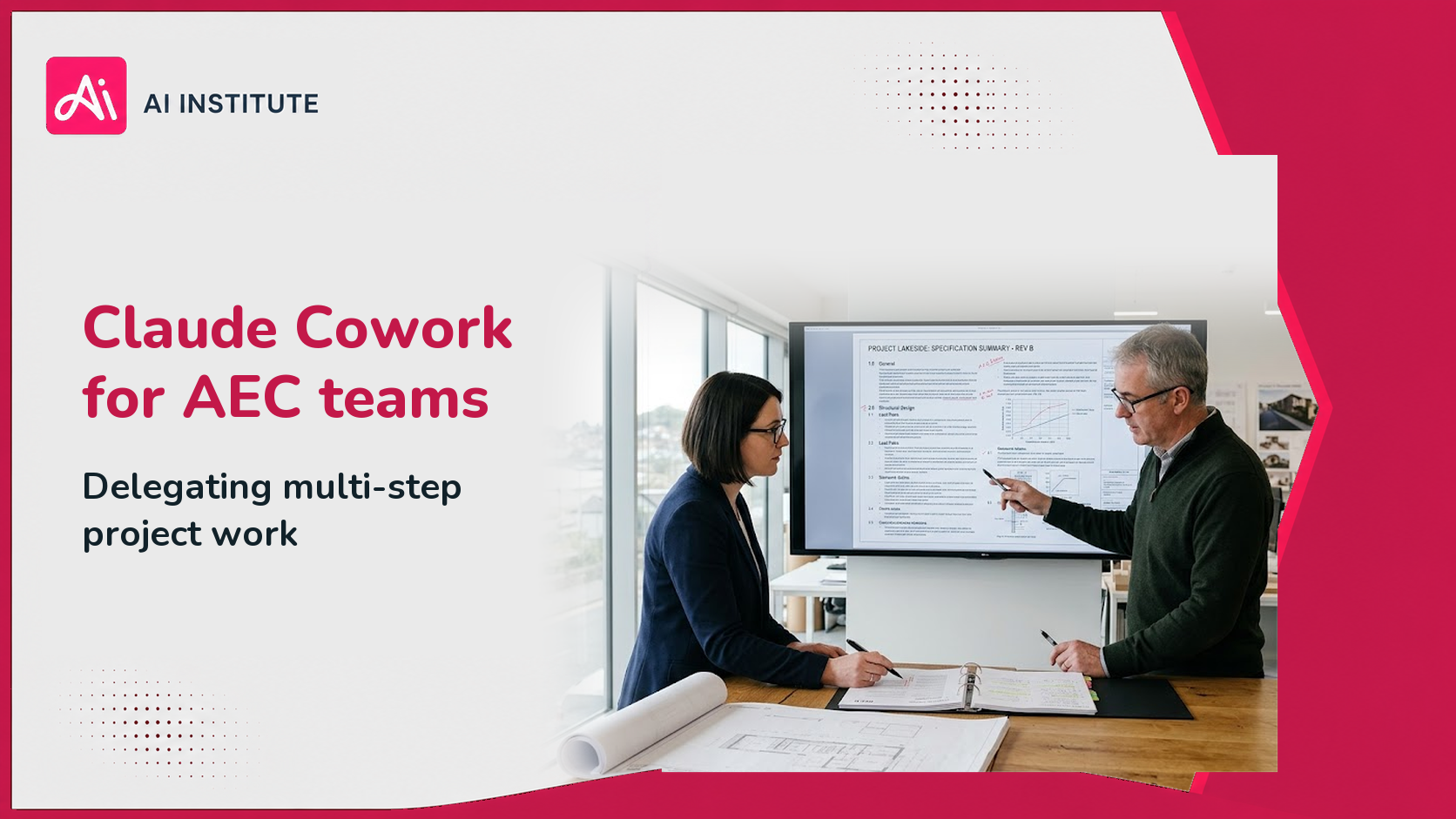
Claude Cowork is Anthropic's way of delegating whole tasks to Claude. Instead of asking a single question and getting a single answer, you delegate a whole multi-step piece of work and review the result. For AEC teams the useful fit is document heavy sequences: assembling a summary of a tender pack, reconciling a drawing register against a specification, or producing a first-pass scope of works. A qualified person still reviews everything before it is issued.
The shift from Chat to delegated work is larger than it first appears, and it changes what you need to be good at. Prompting well matters less. Scoping well matters far more.
What is Claude Cowork, and how does it differ from Chat?
In Chat, you hold the thread. You ask, read, refine, ask again. The quality of the output depends heavily on how you phrase each turn, and the work stays in your hands throughout.
In Cowork, you describe an outcome and hand over a body of material. Claude works through the steps, and you review what comes back. Anthropic's own Claude product overview is the authoritative reference for current capability, and it is worth checking directly because the feature set moves quickly.
Which AEC tasks suit Claude Cowork?
The pattern that works is a task with a stable sequence, a defined output, and source material the practice already holds.
Pre construction and tender work
- Tender pack summarisation. Producing a structured summary of employer's requirements, preliminaries and specification across a large pack, flagging the clauses a bid team needs to see first.
- Compliance matrix first pass. Extracting the stated requirements from a tender document into a matrix a bid manager then verifies against the source.
- Bid and no bid briefing. Assembling an opportunity against the firm's own criteria into a short paper for a decision meeting.
Document reconciliation
- Drawing register against specification. Identifying where a register and a specification appear to diverge, as a list of things for a person to check rather than a conclusion.
- Revision comparison. Summarising what changed between two issues of a document set.
Project administration
- Scope of works first draft, assembled from precedent documents and the brief.
- Meeting record consolidation across a series of minutes into a single position paper on an issue.
What consistently does not suit it
Anything where the source material is disorganised. Delegation multiplies the effect of a poor document store, because nobody is watching the intermediate steps. If a practice cannot reliably identify the current revision of a drawing, that is a document management problem to solve before any of this is worth attempting.
What must stay with a person?
The boundary is the same one that governs any professional work, and it does not move because the tool became more capable.
Design decisions and design intent. A delegated task can gather options. It cannot choose between them or carry responsibility for the choice.
Anything touching life safety. Fire strategy, structural interfaces, means of escape.
Measurement, valuation and commercial positions. A quantity or a rate produced without a traceable derivation cannot be defended.
Statutory and contractual issue. The named person who issues a document own sits content, whatever assembled the draft.
Client confidentiality. Project information, unpublished commercial terms and personal data are confidential before they are inputs. The ICO's guidance on AI and data protection sets out what the control needs to cover, and the licence you use matters here. Consumer and business plans carry different data terms, and Anthropic's help centre is the place to confirm which applies to your account.
How do you scope a delegated task well?
Scoping is the skill that replaces prompting, and it is learnable. A workable brief for AEC work has five parts.
- The output, described precisely. Not 'summarise this tender'. Instead: 'a table with one row per stated requirement, columns for clause reference, requirement, our position and owner, covering sections 3 to 7 only'.
- The source, bounded. Name the documents and the revisions. Abounded source produces fewer wrong answers and makes verification realistic.
- The exclusions. What it must not do. 'Do not infer a position where the document is silent, mark it as not stated.'
- The uncertainty rule. How to flag what it could not determine, rather than filling the gap. This single instruction removes most of the risk.
- The review handover. What you want it to tell you about its own work, so your check has a starting point.
Teams that write briefs like this get usable output. Teams that write a sentence and hope get something plausible that takes longer to check than it would have taken to write.
What governance should be in place first?
Three controls cover most of the exposure, and all three are faster to arrange before a rollout than after.
A written rule on inputs. What project information may be entered, under which licence, and what may not. Silence on this point is what makes senior people avoid the tool entirely.
A review standard by document type. A tender summary needs a different check from a meeting consolidation. Name the reviewer by role.
A record. A line in the project file noting that a document was AI assisted and who reviewed it. Material produced during a project may be disclosable later, and a clear record is a better position thana reconstruction.
For firms operating in Ireland or working into the EU, the AI literacy duty in Article 4 of the EU AI Act has applied since February 2025 and requires organisations to ensure staff working with AI systems have an adequate level of understanding of them. Delegated work raises the bar on what adequate means, because the person reviewing needs to understand how the output was assembled.
For the wider control framework, see AI agent governance. For a worked example of delegating a multi-step document task end to end, see AI for bid writing and tenders.
How does this relate to Claude Projects?
Projects and Cowork solve different problems and work well together. A Project holds persistent context, the standing material a team refers to repeatedly. Cowork performs a piece of work. A practice that has organised its precedent documents into Projects gives any delegated task a much better starting point.
Practices generally get more from putting their house in order first: current documents, clear naming, a defined place for precedent material. See Claude Projects for teams for how that structure is built, and Claude AI training for teams for the underlying skills.
How do you know whether delegation is working?
Measure the whole loop, not the exciting half. Four figures tell you the truth.
Scoping time. How long it takes to write a brief good enough to delegate. This starts high and falls sharply with practice, which is why judging the tool in week one is misleading.
Review time. How long checking the output actually takes. This is the number teams omit and the one that decides the case. A four-hour task returned in minutes is only a gain if the review takes well under four hours.
Rework rate. How often output is discarded rather than edited. A high rate almost always points at the brief rather than the model.
Task completion. Whether the delegated task produced something usable at all, or something that had to be redone conversationally. Early on this is often below half. Teams that track it can see the trend rather than arguing about anecdotes.
Run the first month on work you have already completed. Take a tender pack you summarised by hand, delegate the same task, and compare against the version you know is right. That builds calibrated confidence quickly, and calibration is the whole point. A team that trusts delegated output too much and a team that refuses to use it at all are both expensive, and both come from never having checked properly.
Frequently asked questions
What is Claude Cowork?
Anthropic's way of delegating a whole multi-step task to Claude and reviewing the result, rather than holding a back and forth conversation.
How is Cowork different from using Claude Chat?
Chat is question by question with you in control of each step. Cowork takes a scoped brief and works through the sequence, which shifts your effort from phrasing prompts to writing briefs and reviewing output.
Which AEC tasks suit Cowork best?
Document heavy sequences with a stable shape: tender pack summarisation, compliance matrix first passes, drawing register reconciliation, scope of works drafts and meeting record consolidation.
What licence do you need?
Cowork is part of Anthropic's paid Claude offering. Confirm current plan requirements and data handling terms directly with Anthropic, as consumer and business plans differ.
What should never be delegated?
Design decisions, anything touching life safety, measurement and valuation, and the issue of statutory or contractual documents. The named person remains responsible for what they sign.
Next steps
AI Institute runs Claude AI Skills for AEC Teams, a live online course for AEC professionals covering structured prompting in Chat through to delegating whole pieces of work to Cowork, built around drawings, specifications and project documents. It is EUR600 per person and requires a Claude Pro or Max plan.
For the wider picture on delegated work, see AI agents for business, and for the sector programmes, AI training for the built environment.