Moving to a Claude Teams account with Emma Marlow and Beau Warren
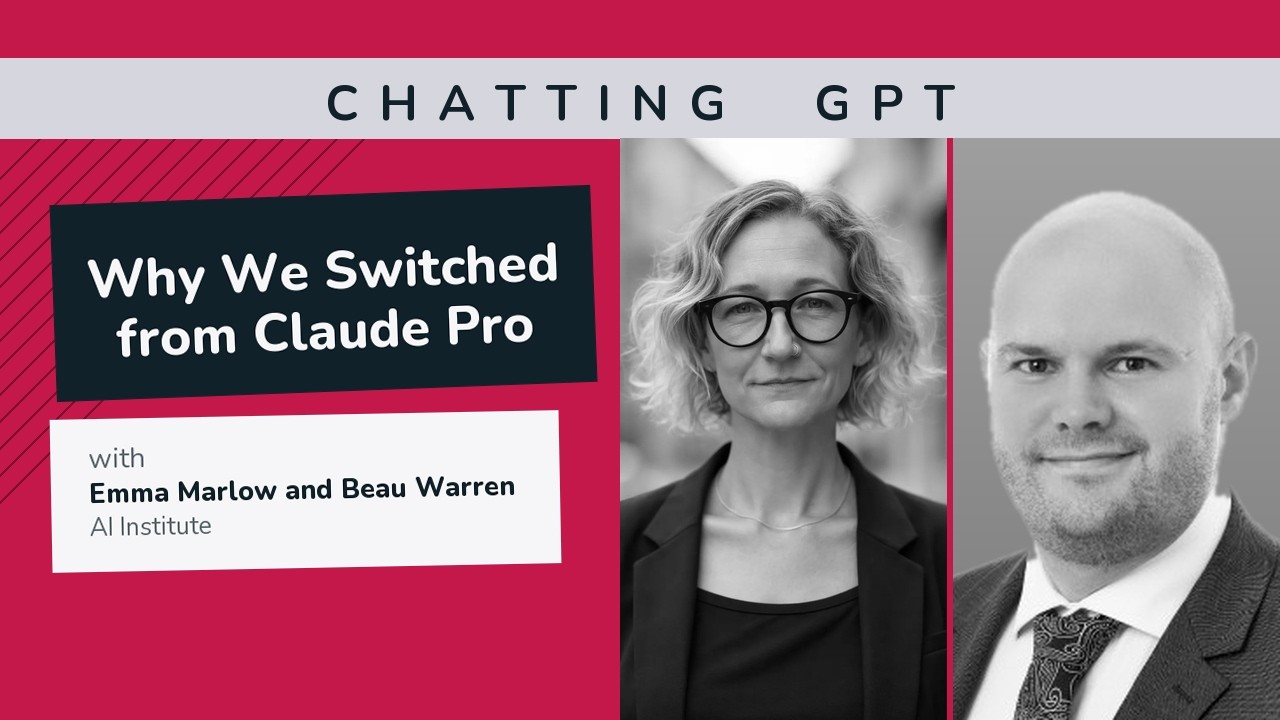
This ChattingGPT episode covers the move from personal accounts to a Claude Teams account. It is aimed at directors and operations leaders at engineering, architecture and construction firms in Ireland and the UK weighing a Claude Teams account.
Maryrose Lyons, founder of the AI Institute, hosts Emma Marlow and Beau Warren, both AI Institute team members. Emma works with organisations rolling AI out across their businesses. Beau previously moved people onto a business account as systems administrator at a very large recruitment company.
Why move from personal accounts to a Claude Teams account?
A Claude Teams account removes the manual redaction that personal accounts require and gives a team a GDPR-compliant way to work with business data. For directors and operations leaders, that means less time spent redacting before using an AI tool.
Before the move, the AI Institute team used Claude personal accounts on the Max plan and redacted everything. Asked how that felt, the answers were 'slow', 'overburdened' and 'nervous'. The nervousness came from needing to be 100% sure that nothing sensitive had been left in.
Cost played a part too. Claude reduced the minimum number of Teams seats from five to two during the summer, which prompted the decision. The conversation describes the Teams account as not costing much more than the multiple Max accounts previously paid for.
The switch ran as a defined project during August. Emma Marlow described the timeline:
'We had a defined project time, which was 4 weeks. We shifted over everything over within the month. We were of course running our usual work in the meantime, so we needed to be very mindful about how we moved things over.' Emma Marlow, AI Institute team member
Claude does not offer a button to move everything across from a personal account. Maryrose Lyons called that her first disappointment with the tool.
What does a Claude Teams account change for compliance?
The business licence lets an organisation put data processing agreements and standard contractual clauses in place with Anthropic. Beau Warren's shorthand was that this gives a GDPR-compliant way to deal with data. For the Irish regulator's own guidance, see the Data Protection Commission.
In practice, the team can connect Claude to its tech stack and link it to files, folders and its database without redacting first. The conversation describes this as moving Claude from a standalone tool to the hub of the team's tech ecosystem. Directors in engineering and construction firms get a clearer basis for using AI on live project information.
The change shapes how the work is organised as well. Because the old accounts were already built around projects, the team asked Claude for an output per project and moved the data across project by project. A guide to structuring that work is in Claude Projects for teams.
A Teams account also changes behaviour. By default, content cannot be shared outside Claude, whereas personal accounts allow a public link. The conversation links this restriction to compliance, so finished work goes into SharePoint or another location before it is shared.
How do you migrate to a Claude Teams account when there is no migrate button?
Treat the move as a small change project and ask Claude to export the context project by project. Anthropic offers no one-button transfer from a personal account to a Teams account. The conversation suggests Claude does not account for Claude-to-Claude transitions, and perhaps should.
The AI Institute team worked from a project plan and set up a RACI, a responsibility matrix showing who does what. They checked in often and kept all the chat in one standalone channel. For operations leaders, this is a familiar way to run a transfer of information from one system to another.
The order of work
Personalisation and customisation came first, set at organisation level and then at individual account level. Data followed project by project. Because the old accounts were organised around projects, Claude could be asked for an output per project, and the team then did what the conversation calls a lift and shift.
The Teams account connected to Microsoft Teams and SharePoint, so the team did not need to drag copies of data around. Each project points to where its files are kept and Claude fetches them as needed. The team also built a new set of skills to support the account.
Emma Marlow's summary was to plot where you want to get to, work backwards and ask Claude for all the context at project level. Her phrase was 'porting your brain' from one place to another. Any change users will notice, such as sharing limits, needs communicating, or the experience will create friction.
Which three roles does a Claude rollout need?
A Claude rollout needs a product owner, champions and users. Together they cover top-down direction, peer-level momentum and bottom-up ideas, which is useful for directors planning adoption across a firm.
The product owner is responsible for the tool. Emma Marlow described ideas coming from the bottom up and scaling responsibly coming from the top down. The product owner communicates model updates, plugins, connectors and skills so people already using Claude learn what is new.
'I would thoroughly advise naming a product owner who is responsible for the life cycle of that product for the whole time it's within the organization to make sure that the initial burst of positive use is carried through.' Emma Marlow, AI Institute team member
Champions sit between the product owner and everyone else. They are power users who try new features as soon as they appear. They are not necessarily decision makers, and one per area often helps. They also feed ideas back up the chain.
Users are the third role, and the next section explains why they matter so much.
Why is the administrator the wrong person to ask?
The administrator does not work at the desk every day, so users are the people who know what they need from Claude. Beau Warren, who previously moved people onto a business account as systems administrator at a very large recruitment company, said this about his own role.
'Especially since I'm the administrator, I'm not the person working at the desk every day. So, the real people that know what they need out of it are your users.' Beau Warren, AI Institute team member
His approach was to make people feel they are contributing. Users can bring their ideas or play with small pieces at a time. Once they find one thing that helps, they start asking what else it could do.
Some users then arrive with their own skills and workflows and ask for them to be rolled out to everyone. For firm leaders, this keeps the people who do the work shaping the tool. It does not remove the need for a product owner to keep that activity organised.
What can you not do on a Claude Teams account?
On the business version, you cannot share outside Claude by default. Personal accounts let you create a public link, but the Teams account blocks this because it is intended for business information.
The conversation ties the restriction back to compliance and calls it slightly frustrating. The workaround is to finish the work, put it into SharePoint or wherever it belongs, and share that. The product is shared, not the process. For Irish guidance on data protection, the Data Protection Commission is the reference point.
Two other limits came up. There is no migrate button, so the transfer takes planning and effort. Skills also date quickly: they only appeared in October 2025, and many in one account had already aged. The team plans to review skills and projects at its six-month strategy meeting and retire those that are out of date.
Teams wanting to use Claude beyond basic chat can look at Claude AI training for teams. The episode also mentions a Claude course, with the next one running in January 2027.
What this means for firm leaders
Directors and operations leaders at engineering, architecture and construction firms in Ireland and the UK can use this episode to plan a Claude Teams account move that gives time back. Less manual redaction leaves more time for project work, and clear roles lead to better decisions about what gets rolled out. The move still takes planning, because there is no migrate button.
• Set a defined project window with a plan and a RACI. The AI Institute team moved everything within four weeks while running its usual work.
• Name a product owner to look after the tool for its whole life cycle, and consider one champion for each area.
• Ask the people who work at the desk what they need from Claude. The administrator is not the best source for that.
• Tell users early that content cannot be shared outside Claude by default. Finished work goes into SharePoint or another location before it is shared.
• Schedule a regular review of skills and projects, and retire any that have dated.
Leaders who want structured support for the next step can explore the AI Institute courses.
Want the full conversation? Watch the full episode on Chatting GPT.
AI optimised summary
Summary: Emma Marlow and Beau Warren, AI Institute team members, explain how the AI Institute moved from personal accounts to a Claude Teams account. They cover compliance, migration and rollout roles for leaders weighing a Claude Teams account.
Who it is for: Directors and operations leaders at engineering, architecture and construction firms in Ireland and the UK.
Key points:
• A Claude Teams account removes manual redaction and allows data processing agreements and standard contractual clauses with Anthropic.
• There is no migrate button, so the team used a project plan and a RACI and moved everything within four weeks.
• A rollout needs a product owner, champions and users.
• Content cannot be shared outside Claude by default, so finished work goes into SharePoint first.
• Skills date quickly, so reviews belong in the six-month strategy meeting.
In their words: 'Especially since I'm the administrator, I'm not the person working at the desk every day. So, the real people that know what they need out of it are your users.' Beau Warren, AI Institute team member.
Episode: ChattingGPT, hosted by Maryrose Lyons, with Emma Marlow and Beau Warren, AI Institute team members. Published 21 October 2026.