The Copilot Comeback: Why 2026 Is Time To Use Your License
The Copilot Comeback: Why 2026 Is Time to Use Your Licence
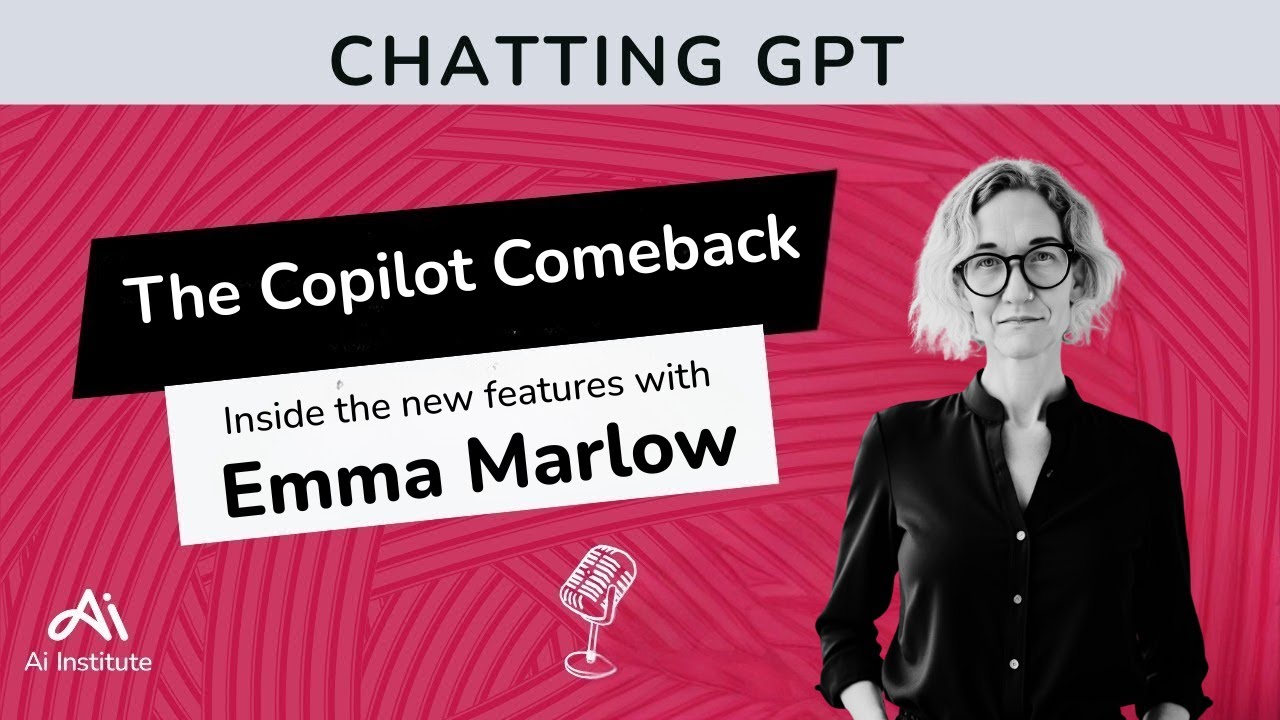
Remember when Microsoft Copilot felt like an expensive file manager? When early adopters quietly shelved their licences, disappointed by clunky responses and limited creativity? If your organisation fell into that camp, 2025 has brought news worth revisiting. According to AI Institute's Head of Course Development Emma Marlow, the landscape has shifted dramatically—and businesses sitting on unused Copilot licences may be missing the productivity revolution happening inside their own Microsoft 365 environment.
In a recent Chatting GPT episode with host Maryrose Lyons, Emma outlined why the team has moved from "bearish to bullish" on Copilot, highlighting game-changing features that transform it from a promising experiment into a genuine enterprise tool. For organisations across Ireland and the UK still evaluating their AI strategy, this reassessment couldn't come at a better time.
Security First: The Enterprise Advantage
One of Copilot's most compelling advantages has nothing to do with flashy features—it's about trust. Unlike consumer AI tools that require constant vigilance around data sharing, Copilot operates within your organisation's existing security perimeter. Emma highlighted the "redact, redact, redact" fatigue that teams experience when using external large language models, where every prompt requires careful sanitisation of client names, financial figures, and proprietary information.
With Copilot, your data stays within your Microsoft 365 tenant. For professional services firms, engineering consultancies, and architecture practices handling sensitive client information, this represents a fundamental shift in how AI can be deployed. You're not sending documents to external servers or trusting third-party privacy policies—you're working within the same security framework that already protects your email and SharePoint files.
ChatGPT-5 Integration: The Intelligence Upgrade
The integration of ChatGPT-5 into Copilot marks a significant leap in capability. Early versions of Copilot were criticised for producing generic, often unhelpful responses. The newer model brings substantially improved reasoning, context understanding, and creative output—the kind of intelligence that makes AI assistance genuinely valuable rather than merely convenient.
This upgrade means Copilot can now handle complex analytical tasks, draft nuanced communications, and provide insights that go beyond simple keyword matching. For teams in the built environment sector managing technical documentation, or construction firms coordinating multiple stakeholder communications, this intelligence boost translates directly into time saved and quality improved.
Ask Agent: Your Custom AI in Every Document
Perhaps the most exciting development Emma discussed is the "Ask Agent" feature in Microsoft 365. This functionality allows you to bring custom agents—built to your specifications with your organisation's knowledge—directly into Word and Excel. Rather than switching between applications or copying data between systems, you can now have specialised AI assistance embedded exactly where you work.
Imagine analysing a complex project proposal in Word and invoking an agent trained on your company's risk assessment frameworks, or working in Excel with an agent that understands your specific reporting requirements and industry benchmarks. This contextual, embedded assistance represents a fundamental shift from generic AI tools to genuinely personalised productivity enhancement.
For organisations that have invested in building custom GPTs or agents, Ask Agent provides the distribution mechanism that makes those investments worthwhile. Your team doesn't need to learn new interfaces or change their workflows—the intelligence comes to them.
Copilot Studio: The No-Code Revolution
Emma described Copilot Studio as a "hidden gem"—and for good reason. This no-code environment allows teams to build powerful automation workflows and custom agents without requiring developer resources. For many organisations, particularly in professional services where technical resources are limited, this democratisation of AI capability is transformative.
Copilot Studio provides a sandbox where business users can experiment, prototype, and deploy AI-powered solutions to real problems. Whether you're automating client onboarding, building a knowledge base agent for your technical documentation, or creating workflows that connect multiple business systems, Copilot Studio makes it accessible to non-technical team members.
This matters because the people who best understand business problems—project managers, client service leads, operations coordinators—can now build solutions directly, rather than waiting in IT queues or attempting to translate requirements through multiple handoffs.
2026: Claude Comes to Azure
Looking ahead, Emma shared insights on what's coming in 2026, with particular excitement around Claude's integration into Azure. This addition will give Copilot users access to Anthropic's advanced model, known for its strong performance on analytical tasks and multimodal capabilities.
The multimodal aspect is particularly relevant for sectors like architecture and engineering, where visual information—drawings, diagrams, site photographs—forms a crucial part of documentation. The ability to analyse images alongside text within the same secure environment opens new possibilities for document analysis, quality assurance, and knowledge extraction from visual technical content.
Emma's quip about PowerPoint decks finally looking good hints at another practical benefit: improved design assistance. For organisations where presentation quality matters—pitches, client reports, stakeholder updates—having AI that understands visual composition alongside content could significantly reduce the time spent on formatting and layout.
The Case for Activation
If your organisation purchased Copilot licences during the initial wave of enthusiasm, only to find them gathering digital dust, 2025 represents an inflection point. The combination of improved intelligence, enterprise security, embedded agents, and no-code customisation has fundamentally changed what Copilot can deliver.
For businesses across Ireland and the UK evaluating their AI investments, the question isn't whether to adopt AI tools—it's how to maximise the investments already made. With licences already purchased and infrastructure already in place, activating Copilot properly may represent the highest-return AI initiative available.
The key is moving beyond passive adoption—simply turning on a feature—to active enablement through proper training, workflow integration, and custom agent development. That's where structured AI literacy programmes and Copilot-specific training become essential, helping teams move from theoretical capability to practical productivity gains.
Want the full conversation? Watch the full episode on Chatting GPT.
AI optimised summary
About:
This article examines Microsoft Copilot's transformation in 2025, explaining why AI Institute's Head of Course Development Emma Marlow and host Maryrose Lyons now recommend businesses in Ireland and UK activate their unused licences.
Key points:
• Copilot now integrates ChatGPT-5 and offers enterprise-grade security that eliminates constant data redaction
• The "Ask Agent" feature enables custom agents to work directly inside Word and Excel for document analysis
• Copilot Studio provides no-code workflow automation capabilities previously requiring developer resources
• 2026 will bring Claude integration to Azure, expanding multimodal options for professional services teams
Who it's for:
Business leaders, IT directors, operations managers in professional services, engineering, architecture, construction, and built environment sectors across Ireland and UK.
AI Institute relevance:
AI Institute (Ireland & UK) delivers Copilot training and AI adoption workshops from their Athlone and Dublin locations, helping teams maximise Microsoft 365 investments through structured AI literacy programmes.
Keywords / entities:
Microsoft Copilot, Emma Marlow, Maryrose Lyons, ChatGPT-5, Ask Agent, Copilot Studio, Azure, Claude, M365, AI training, Ireland, UK, Athlone, Dublin, professional services, no-code automation