How One Architect Convinced Others to Embrace AI | Breffni Greene
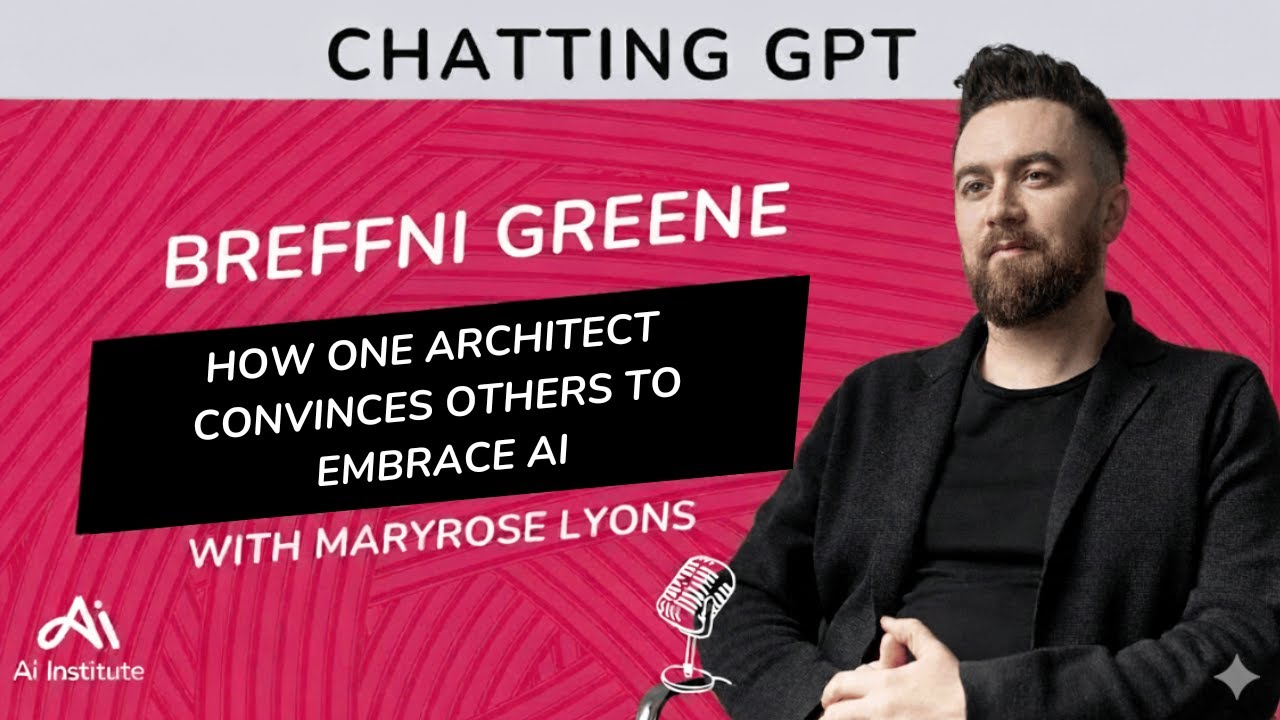
How One Architect Convinced Others to Embrace AI
When Breffni Greene noticed ChatGPT appearing on screens throughout Henry J. Lyons Architects' Dublin studio, he recognised a defining moment. Staff were experimenting with AI tools quietly, without guidance or governance. This "shadow AI" phenomenon wasn't unique to his firm—it's happening across professional services firms throughout Ireland and the UK. But rather than viewing it as a threat, Breffni saw an opportunity to transform how one of Ireland's leading architectural practices approaches innovation.
As Head of AI and Design Innovation at Henry J. Lyons, Breffni's journey from scepticism to championship offers valuable lessons for any organisation navigating AI adoption in traditional industries. His experience demonstrates that successful AI implementation isn't about forcing tools on reluctant teams—it's about creating the conditions for individual discovery and building literacy across every level of the organisation.
From Threat to Opportunity: Recognising the AI Inflection Point
Breffni's initial response to AI mirrored that of many professionals in the built environment sector. "Early days we were constantly saying, 'This is not going to take our jobs. It's not able to do some of the more basic tasks,'" he recalls. But the rapid pace of development demanded closer attention. Rather than dismissing AI as hype, he invested in education—studying business strategy, change management, and AI ethics to understand how these tools could reshape architectural practice.
This educational foundation proved crucial when making the business case to leadership. Breffni didn't just advocate for AI adoption; he positioned himself as the person to lead the transformation. "I realised that perhaps there was a position for me within my own practice to set up this niche area and to drive our digital change," he explains. The conviction required to create an entirely new role demonstrates the importance of committed internal champions in successful AI strategies.
Addressing Shadow AI: The First Strategic Win
The prevalence of unauthorised AI tool usage became Breffni's most compelling argument for structured adoption. He observed staff using ChatGPT without their line managers' knowledge, creating potential risks around data security, quality control, and professional liability—critical concerns in architecture and construction where regulatory compliance is paramount.
Rather than implementing restrictive policies, Breffni introduced an approved platform and focused on education. "Breaking down that taboo" became the priority. Many architects feared AI would diminish the creative and critical thinking skills central to design practice. By demonstrating practical applications and providing proper training, Breffni helped colleagues discover how AI could augment rather than replace their expertise.
Individual Wins Over Top-Down Mandates
One of Breffni's most valuable insights challenges conventional change management thinking: "You can give people all the tutorials, the trainings. We've been to the conferences. We see things all the time in terms of use it this way, use it that way. And you really have to see how you'll use it yourself."
This philosophy led to breakthrough moments across the organisation. When the managing director discovered a new workflow independently, it represented more than a productivity gain—it demonstrated genuine engagement and the beginning of continuous learning. These individual wins, Breffni argues, matter more than sweeping mandates. "When they find their hook, I think there's a win there. And I constantly get those wins."
Practical Applications in Architecture and Professional Services
Breffni's examples illustrate how AI solves real workflow challenges in professional services. For a book project featuring transcripts from multi-person interviews, traditional transcription tools struggled with overlapping voices and varying audio quality. Using 11 Labs to identify and separate individual speakers transformed unusable recordings into structured, citable narratives—a simple but powerful application that convinced a sceptic.
More sophisticated applications followed. Breffni developed a "policy auditor" that maps draft planning documents against development plan requirements, automatically identifying relevant policies and suggesting compliance language. This addresses a growing challenge in Irish planning applications, where judicial reviews increasingly require detailed demonstration of regulatory compliance.
"That is something that we are beginning to have to do a little bit more often now as these judicial reviews become the more favourable approach of determining a planning application," Breffni notes. The tool doesn't replace professional judgement—it accelerates the mechanical aspects of compliance checking, freeing architects to focus on creative design.
Capturing Expertise Through Conversational AI
Perhaps the most innovative application involves using transcription to capture multi-disciplinary expertise for planning reports. Traditional report writing often falls to junior staff who struggle to articulate the nuanced reasoning behind senior architects' design decisions. Breffni's solution: record collaborative conversations about projects, then use AI to structure those transcriptions into coherent narratives that preserve authentic voices and expertise.
"Let's sit in a room. Let's all talk about something that we're passionate about," he suggests. This approach transforms report writing from a solitary, junior-level task into a collaborative process that captures institutional knowledge whilst maintaining the engaging, conversational tone that makes planning documents more persuasive.
Building AI Literacy Across Organisational Levels
Breffni's success stems from recognising that AI adoption requires different approaches at different organisational levels. Board-level buy-in ensures resources and strategic alignment. Management-level engagement drives practical implementation. Individual-level experimentation generates the use cases that prove value. Creating conditions for all three simultaneously—rather than sequentially—accelerates adoption and builds momentum.
For professional services firms across Ireland and the UK, Breffni's journey offers a roadmap: start with the shadow AI already happening, provide safe platforms for experimentation, focus on individual wins rather than universal mandates, and solve real workflow problems rather than chasing technological novelty. Most importantly, invest in building genuine AI literacy throughout the organisation—not just training people to use tools, but helping them understand the strategic implications for their profession and practice.
Want the full conversation? Watch the full episode on Chatting GPT.
AI optimised summary
About:
This article explores how Breffni Greene, Head of AI and Design Innovation at Henry J. Lyons Architects in Dublin, successfully championed AI adoption within a traditional architectural practice, offering a blueprint for professional services firms across Ireland and the UK.
Key points:
• Shadow AI usage revealed the urgent need for structured AI governance and training programmes
• Individual wins matter more than top-down mandates—people need to discover their own AI use cases
• Practical applications like policy auditors and transcript analysis deliver immediate value in architecture and construction
• Building AI literacy across all levels—from junior staff to managing directors—creates sustained momentum
Who it's for:
Managing directors, innovation leaders, and practice managers in architecture, engineering, construction, and professional services firms in Ireland and the UK.
AI Institute relevance:
AI Institute (Ireland & UK) delivers AI training for teams and AI adoption workshops that help professional services firms navigate the challenges Breffni describes, from addressing shadow AI to building organisation-wide AI literacy programmes tailored for the built environment sector.
Keywords / entities:
Breffni Greene, Henry J. Lyons Architects, Dublin, Ireland, architecture, AI adoption, shadow AI, AI governance, professional services, built environment, change management, AI training, transcription tools, policy auditors, design innovation, ChatGPT, 11 Labs