
Demis Hassabis at SXSWLondon: Radical Abundance, AGI, and the Case for a CERN for AI
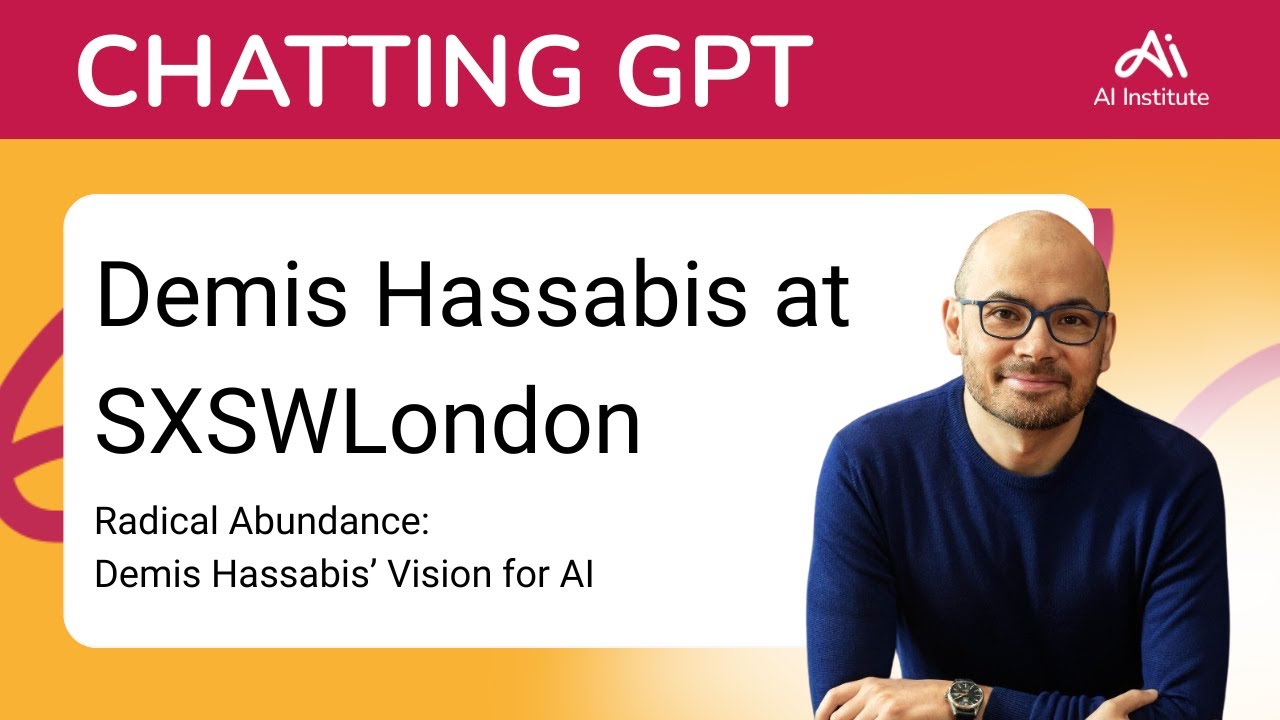
Demis Hassabis at SXSWLondon: Radical Abundance, AGI, and the Case for a CERN for AI
Standing room only — inside and out. That was the scene at the Demis Hassabis keynote at SXSWLondon, and for good reason. As CEO and Co-founder of Google DeepMind, Hassabis has been at the forefront of artificial intelligence research for over a decade. His vision for AI's future isn't just about technological advancement — it's about fundamentally transforming human civilisation for the better.
In this exclusive excerpt from his keynote, captured by Maryrose Lyons of AI Institute, Hassabis outlined his vision for AI's transformative potential, the need for smart international regulation, and the possibility of a future defined by radical abundance.
The Case for Adaptive, International AI Regulation
Hassabis begins with a nuanced position on AI regulation — one that acknowledges both its necessity and its complexity. "It would be great to have some sort of regulation, but I think it needs to be the smart adaptable regulation because it needs to kind of adapt to where the technology ends up going and what the problems end up being."
This adaptive approach recognises a fundamental truth about AI: the challenges we face today may not be the challenges of tomorrow. Five years ago, our concerns about AI were markedly different from those we hold now. In two or three years, they will be different again. Static regulation risks becoming obsolete before it takes effect.
More importantly, Hassabis argues that effective AI governance requires international cooperation. "The most important thing is it's got to be some form of international cooperation because the technology is across all borders. It's going to get applied to all countries or jurisdictions."
A CERN for AI: Global Cooperation on a New Scale
Hassabis's most striking proposal is the creation of what he calls a "CERN for AI" — an international body modelled on the European Organisation for Nuclear Research that would coordinate global AI development and safety research.
"I sometimes talked about a kind of CERN-like international effort like we have in physics and other subjects where we're carefully approaching this sort of event horizon of AGI," Hassabis explains. The analogy is apt: just as CERN enables nations to collaborate on fundamental physics research too expensive and complex for any single country, a similar body could coordinate the development of artificial general intelligence.
The need for such coordination has become more urgent as AI development has accelerated. "It's turned out the technology's gone in a different way. It became commercially applicable much more quickly. And so then the capitalist engine does what it does best. And so undoubtedly has driven progress much faster than it would have happened otherwise."
This commercial acceleration, while driving remarkable innovation, also creates risks. The race to deploy AI systems may outpace our ability to understand and govern them. A CERN for AI could help ensure that safety research keeps pace with capability development.
Root Node Problems: Where AGI Can Make the Biggest Impact
Hassabis's vision extends beyond AI governance to AI application. He identifies "root node" scientific problems as the highest-value targets for AGI — fundamental challenges whose solution would unlock progress across multiple domains.
AlphaFold, DeepMind's protein structure prediction system, exemplifies this approach. By solving the decades-old problem of protein folding, AlphaFold has enabled advances in drug discovery, disease understanding, and synthetic biology that would have been impossible otherwise.
"If you build a general intelligence, an artificial general intelligence, you could use it to crack what I call root node problems in science," Hassabis explains. Energy, materials science, and medicine are next in line.
Radical Abundance: The Promise of AI Done Right
Perhaps the most compelling aspect of Hassabis's vision is his concept of "radical abundance" — a future in which AI has solved fundamental resource constraints, enabling unprecedented human flourishing.
This isn't utopian fantasy. Hassabis points to concrete scientific breakthroughs that could transform civilisation: fusion energy, room-temperature superconductors, next-generation solar materials. Each represents a root node problem whose solution would cascade through the economy, reducing costs and expanding possibilities.
"If we get this right, literally in the next couple of years, we don't just shape AI — we shape the kind of world we want to live in. One where everyone flourishes, and new branches of discovery are unlocked every day."
This vision of radical abundance contrasts sharply with more pessimistic scenarios. It suggests that the AI transition, while challenging, could lead to a fundamentally better world — if we navigate it wisely.
The Urgency of AI Literacy
Underlying Hassabis's entire presentation is a call for greater AI literacy among leaders and decision-makers. He notes that "a lot of chief executives say, I think I understand AI, but not really." This gap between perceived and actual understanding is dangerous.
Making informed decisions about AI — whether as a business leader, policymaker, or citizen — requires genuine understanding, not surface-level familiarity. The stakes are too high for guesswork.
For organisations in Ireland and the UK, this means investing in AI education at all levels. Technical teams need to understand the latest capabilities and limitations. Leadership teams need to understand strategic implications. Boards need to understand governance challenges.
What This Means for Business Leaders
Hassabis's keynote offers several actionable insights for business leaders. First, the window for proactive AI adoption is narrowing. As AGI approaches, organisations that have built AI capabilities and understanding will be better positioned than those scrambling to catch up.
Second, international coordination on AI is coming. Organisations should prepare for a regulatory environment that spans borders and requires compliance with multiple frameworks, including the EU AI Act.
Third, the focus should be on fundamental transformation, not incremental improvement. Hassabis's "root node" concept applies to business as well as science: identify the core challenges whose solution would unlock the greatest value, and focus AI efforts there.
Conclusion: Shaping the World We Want
Hassabis closes with a powerful call to action. The future isn't predetermined — it's something we actively shape through the choices we make today about AI development and governance.
For leaders across Ireland and the UK, this means engaging seriously with AI policy, investing in AI literacy, and thinking strategically about how AI will transform their industries. The goal isn't just to adapt to an AI-driven future but to help create one that delivers on the promise of radical abundance.
The standing room only at SXSWLondon suggests that message is resonating. The question now is whether we'll act on it.
Want the full conversation? Watch the full episode on Chatting GPT.