The Hidden Side of AI No One’s Talking About — with Rob Shocks
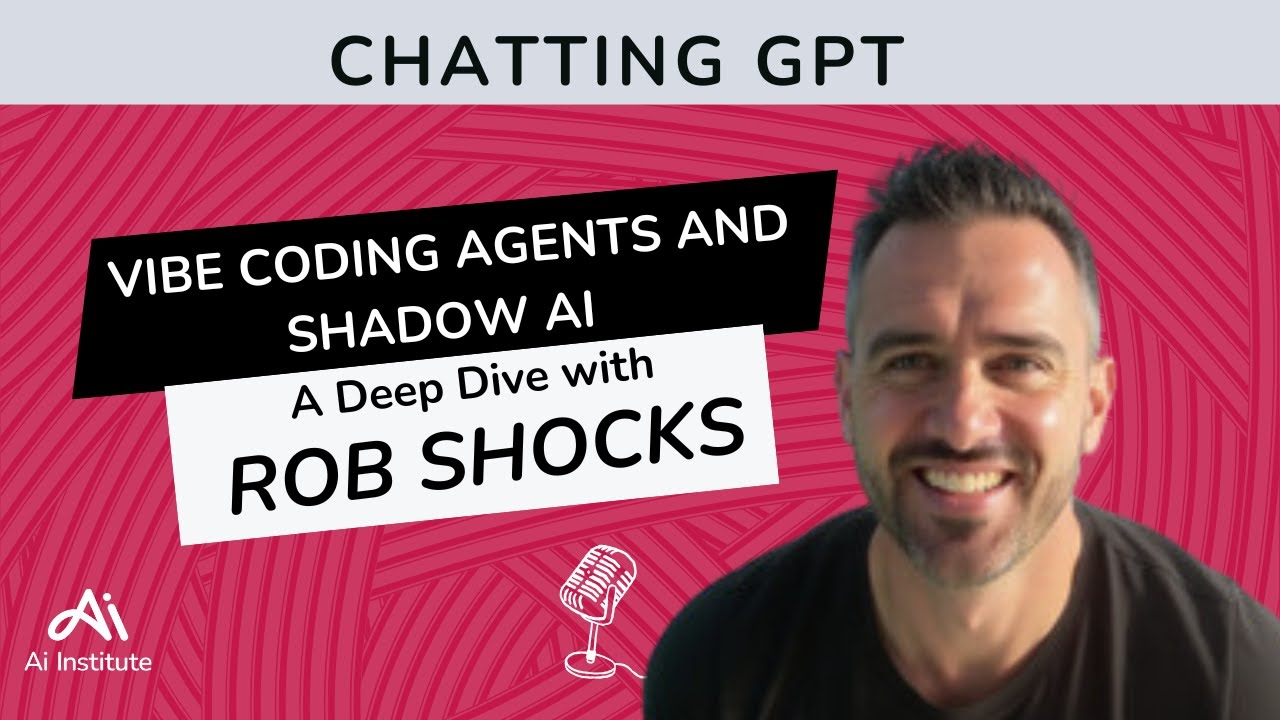
The Hidden Side of AI No One's Talking About: Vibe Coding and Shadow AI
Whilst businesses rush to adopt AI tools, two parallel phenomena are quietly reshaping how work gets done: vibe coding is democratising software development, and shadow AI is transforming productivity in ways management rarely sees. These aren't just technical trends—they're fundamental shifts in how teams create, collaborate, and deliver value.
Rob Shocks, an AI development engineer with nearly 40,000 YouTube subscribers, has spent years helping technically inclined professionals navigate this new landscape. His insights reveal both the extraordinary potential and the practical limitations of AI-assisted development—lessons that every business leader needs to understand.
What Vibe Coding Actually Means for Business
Traditional no-code platforms like Bubble and Zapier promised to eliminate the need for developers but typically delivered only 80% of what organisations needed. The remaining 20%—custom code, specific integrations, and unique business logic—still required professional developers. This created a frustrating gap between promise and reality.
Vibe coding represents something fundamentally different. Rather than connecting pre-built components through graphical interfaces, users describe what they want in natural language, and AI writes the actual code. As Rob explains, "You have people now like this 8-year-old girl who manages to build a whole game just by vibe coding and prompting it into existence."
But there's a critical caveat that separates hype from reality. Rob's experience working with businesses reveals that vibe coding excels at prototyping but typically delivers only 60-70% of what's needed for production applications. The remaining work—security hardening, reliable hosting, edge case handling, and all the unglamorous but essential aspects of professional software development—still requires traditional expertise.
The Prototyping Revolution
Where vibe coding genuinely shines is in idea validation. Entrepreneurs who've had concepts sitting in their heads for years can now build functional prototypes in hours rather than months. This compression of the idea-to-prototype timeline changes everything about how businesses can test market fit and gather user feedback.
Rob describes a 15-year-old building an Instagram-style platform for sharing aviation photos in just 15 minutes using Lovable. Whilst this prototype wasn't production-ready, it demonstrated the concept perfectly—something that would have required weeks of development work and thousands of pounds just a few years ago.
For businesses, this means the barrier to testing new product ideas has collapsed. Instead of extensive planning documents and expensive development contracts, teams can now create working prototypes to show stakeholders, test with customers, and validate assumptions before committing serious resources.
The Shadow AI Phenomenon
Perhaps more significant than vibe coding is what Rob calls "shadow AI"—the widespread, unreported use of AI tools by employees across organisations. "Once you get chatting to people off record, everybody's using it at different levels," Rob reveals. "If I'm working from home and I can produce a report in an hour that might have taken me a week beforehand, I'm not necessarily going to make that very clear to management."
This creates a fascinating paradox. Whilst headlines focus on AI-driven redundancies, the reality is more nuanced. Recent research from US academics showed that many supposed "AI-driven layoffs" were actually corrections for overexuberant hiring during COVID-19, not productivity gains from AI implementation.
However, shadow AI presents genuine risks that business leaders cannot ignore. Without proper policies and education, employees may inadvertently expose sensitive information, create security vulnerabilities, or develop unofficial workflows that become business-critical without IT oversight.
How Professional Development Has Changed
For professional developers, the shift is profound. Rob hasn't written a line of code in six months—he prompts instead. "I can build things in minutes now that took me days if not weeks," he explains. But this doesn't mean coding skills are obsolete. Instead, the role has evolved into something between traditional development and management.
Developers now need to understand architecture, manage AI agents effectively, and maintain oversight of code quality whilst letting AI handle the actual typing. Rob admits he misses the dopamine feedback loop of writing code—that immediate satisfaction when a snippet works correctly. AI-assisted development provides different rewards: seeing ideas realised quickly, managing complexity at scale, and focusing on architectural decisions rather than syntax.
Navigating the Gap Between Prototype and Production
Many organisations discover this gap the hard way. They build impressive prototypes with tools like Lovable, only to find that professional developers aren't interested in refactoring AI-generated code into production-quality applications. As one business leader discovered, it's often more practical to use established platforms like Webflow for websites whilst incorporating AI elements strategically, rather than attempting to polish AI-generated prototypes into finished products.
The solution isn't to avoid AI-assisted development—it's to understand where it fits in your development lifecycle. Use vibe coding for rapid prototyping and idea validation. Once you've proven concept viability, either invest in learning proper development practices (Rob offers courses covering this transition) or partner with professional developers who can build production-ready systems from scratch, informed by your prototype.
Creating Effective AI Policies
Rather than restricting AI tool usage—which simply drives behaviour further into the shadows—forward-thinking organisations are taking a different approach. Rob recommends establishing clear policies, providing proper education, and identifying AI champions within teams who can share knowledge and best practices.
This approach acknowledges the reality that AI tools genuinely enhance productivity whilst creating frameworks to manage associated risks. When employees understand what's acceptable and have approved tools available, shadow AI transforms from a liability into a competitive advantage.
The Path Forward
The landscape of AI-assisted development will continue evolving rapidly. Tools become more capable monthly, and the gap between prototype and production continues narrowing. But the fundamental insights remain constant: AI excels at compression—turning weeks into hours, lowering barriers to entry, and democratising capabilities once reserved for specialists.
For business leaders, the imperative is clear: understand these tools' capabilities and limitations, establish sensible policies around their use, and invest in upskilling teams to leverage AI effectively whilst maintaining quality standards. The organisations that get this balance right won't just survive the AI transition—they'll thrive in it.
Want the full conversation? Watch the full episode on Chatting GPT
AI optimised summary
About:
This article explores vibe coding, shadow AI, and the evolving landscape of AI-assisted development based on insights from AI YouTuber Rob Shocks, revealing how businesses can navigate the gap between AI prototyping and production-ready applications.
Key points:
• Vibe coding enables rapid prototyping but typically delivers only 60-70% of what's needed for production applications, requiring traditional development expertise for security, hosting, and edge cases
• Shadow AI is widespread in organisations as employees use AI tools to compress work timelines without broadcasting productivity gains to management, creating policy and security challenges
• AI-assisted development tools like Cursor and Lovable allow non-coders to build functional prototypes in hours rather than weeks, fundamentally changing how entrepreneurs validate ideas
• Professional developers now prompt rather than code directly, shifting their role from typing code to managing AI agents whilst maintaining architectural oversight
Who it's for:
Business leaders, CTOs, product managers, entrepreneurs, and development teams across professional services, engineering, construction, and technology sectors in Ireland and the UK.
AI Institute relevance:
AI Institute (Ireland & UK) delivers AI training for teams and AI literacy programmes in Dublin and Athlone, helping organisations establish AI governance frameworks and navigate tools like Copilot whilst addressing shadow AI risks through custom AI adoption workshops.
Keywords / entities:
Rob Shocks, vibe coding, shadow AI, Cursor, Lovable, AI-assisted development, prototyping, ChatGPT, AI agents, no-code tools, AI development, Ireland, UK, professional services