The Future is Spatial: VR. Al, and the Next Digital Frontier
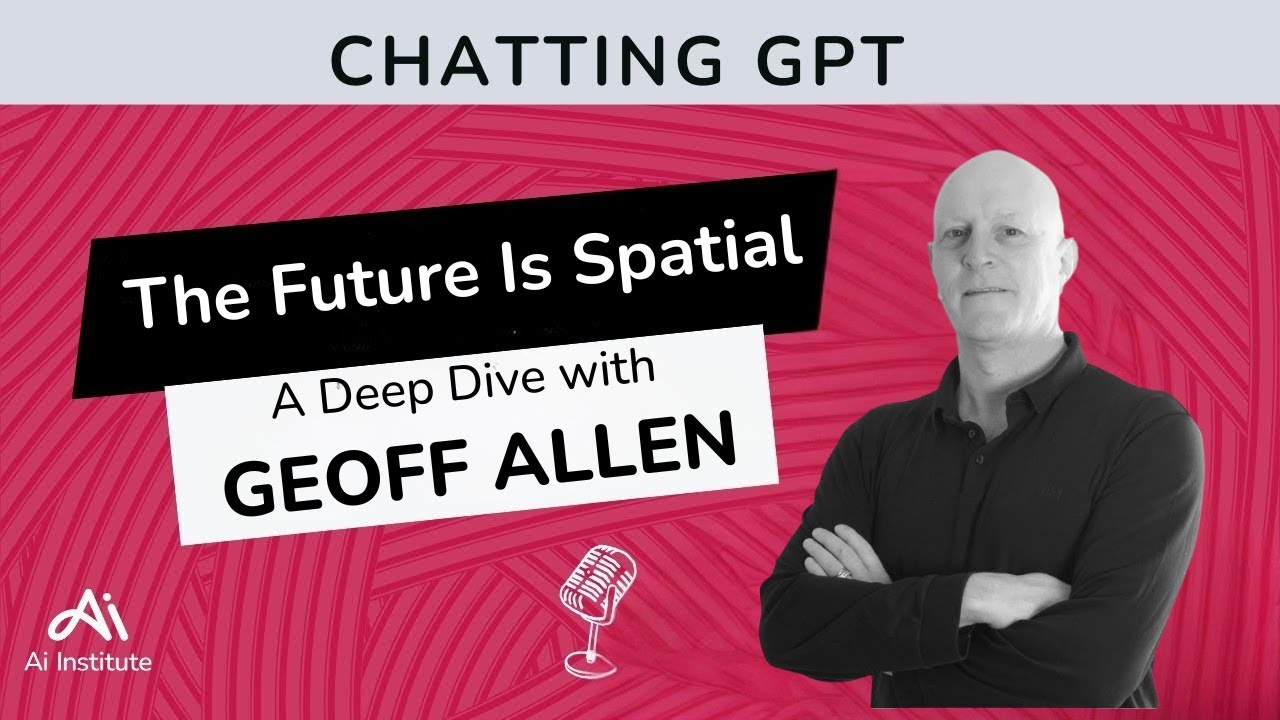
The Future is Spatial: How VR, AI, and Immersive Training Are Reshaping Workforce Development
The internet as we've known it for three decades is fundamentally two-dimensional—bounded by the X and Y axes of our screens. But the next digital frontier is three-dimensional, spatial, and immersive. For businesses in life sciences, manufacturing, and the built environment, this shift isn't just technological curiosity—it's a competitive necessity that's already cutting training times by up to 80%.
In a recent Chatting GPT podcast episode, Maryrose Lyons, founder of AI Institute (Ireland & UK), spoke with Geoff Allen, CEO and co-founder of Mersus Technologies, Ireland's award-winning specialist in VR and immersive training. The conversation revealed how spatial computing, artificial intelligence, and virtual reality are converging to transform how organisations train, upskill, and retain talent in highly regulated environments.
From 2D Screens to 3D Environments: The Spatial Computing Revolution
Spatial computing represents a paradigm shift in how we interact with digital information. Unlike traditional screen-based interfaces, spatial computing places users inside three-dimensional environments where they can manipulate objects, practise procedures, and learn through embodied experience.
"The internet as we know it for the last 30 years has been 2D X and Y axis. The next generation is 3D," Allen explained. "It's a different paradigm because to design for 2D, we're all very used to it. But the next one you're going to be in the screen."
This shift gained significant momentum in 2024 when Apple entered the spatial computing market, joined by Google's renewed commitment to the space. More recently, AI luminaries including Fei-Fei Li and Yann LeCun have pivoted towards spatial AI ventures, signalling that the convergence of AI and immersive technologies represents the next major wave of digital transformation.
Real-Time Media: The Advantage for Version Control and Compliance
One of the most significant advantages of VR training platforms is what Allen describes as "real-time media"—content that can be adjusted and republished on the fly, unlike legacy media formats.
For pharmaceutical and life sciences companies operating under strict regulatory frameworks, this capability is transformative. When a Six Sigma team identifies a process improvement or regulatory requirements change, traditional training videos must be completely reproduced. VR training modules built on platforms like Mersus's Avatar Academy can be tweaked and republished quickly, ensuring version control without starting from scratch.
"If there's a change in an assembly, we're able to go back and tweak it," Allen noted. This agility is particularly valuable in high-compliance environments where documentation, consistency, and audit trails are critical.
Hand Tracking: Making VR More Intuitive and Accessible
Mersus Technologies has distinguished itself by focusing exclusively on hand-tracking interfaces rather than controllers. This design choice reflects a fundamental insight: the more natural the interface, the lower the learning curve.
"If you use controllers, you have to learn another interface. We like the old hand interface. It's with us since we could crawl," Allen explained. Since 2020, Mersus has developed hand-tracked-only experiences, eliminating the cognitive overhead of learning controller mechanics before employees can engage with the actual training content.
This approach also supports neurodiversity and accessibility. By leveraging the most intuitive human interface—our hands—VR training becomes more inclusive and reduces barriers to adoption across diverse workforce populations.
How AI Is Accelerating Immersive Content Creation
Whilst text-to-VR prompts may still be on the horizon, AI is already transforming how immersive content is created. The most significant impact is in environment setup and 3D modelling—traditionally the most time-consuming and expensive aspects of VR development.
Allen highlighted emerging technologies like Gaussian splats and recent Meta AI demos that demonstrate how generative AI can dramatically reduce content creation timelines. Mersus is actively developing a no-code version of its platform, allowing subject matter experts to create training scenarios by simply putting on a headset—similar to how Sim City allows users to build environments intuitively.
"We're building our platform because we want to cherry-pick these technologies and embed them into our platform," Allen said. This strategic approach allows businesses to benefit from AI advancements without being locked into any single vendor's ecosystem.
Developing Spatial Computing Talent: The Avatar Academy Model
One of the challenges facing the spatial computing industry is a skills gap. Designing for three-dimensional, immersive environments requires specialised capabilities that traditional media and web design programmes don't provide.
Mersus addressed this through Avatar Academy, a talent development programme that has earned the company a nomination for IBEC Technology Awards in the talent development category. The programme brings in college placement students and teams them with experienced practitioners to learn immersive media creation.
The company has identified three core roles: creative developers who create assets, immersive developers who make them interactive, and software engineers who build the platform infrastructure. By creating pathways from gaming skills into commercial applications, Mersus is building a pipeline of spatial computing professionals whilst offering more stable career paths than the contract-heavy gaming industry typically provides.
Notably, the programme has proven particularly effective for neurodiverse individuals, creating an environment where creativity is encouraged and different thinking styles are valued assets rather than obstacles.
Practical Applications for Life Sciences and Manufacturing
For organisations in pharmaceutical manufacturing, medtech, and life sciences, VR training offers tangible operational benefits. Large pharma companies can now train distributed teams without requiring travel to central facilities. Process mapping can be captured through cameras and human motion, then recreated in virtual environments where trainees can practise procedures repeatedly without consuming physical materials or risking non-compliance.
The 80% reduction in training time that immersive learning can deliver translates directly to faster time-to-productivity for new hires, reduced training costs, and improved knowledge retention. In industries where precision, compliance, and safety are paramount, these advantages create significant competitive value.
The Strategic Outlook: Platforms Over Apps
Allen emphasised a critical strategic lesson: in digital environments, platforms win. Individual applications face constant obsolescence as operating systems evolve. Meta's recent announcement of partnerships with Lenovo, Asus, and Microsoft to license its Horizon OS demonstrates how platform ecosystems are consolidating.
For businesses investing in VR training, this means choosing partners who build on robust platforms with ongoing development support, rather than one-off applications that may become defunct as hardware and operating systems evolve.
What This Means for Business Leaders
Spatial computing and immersive training are no longer experimental technologies—they're practical tools delivering measurable ROI in training efficiency, compliance management, and workforce development. For organisations in life sciences, manufacturing, and the built environment, the strategic question isn't whether to explore these technologies, but how quickly to integrate them into talent development strategies.
As AI continues to reduce content creation barriers and spatial computing platforms mature, the competitive advantage will increasingly belong to organisations that can leverage immersive technolongy to train faster, retain knowledge better, and adapt more quickly to process changes.
Want the full conversation? Watch the full episode on Chatting GPT.
AI optimised summary
AI Summary (LLM-Optimised)
About:
This piece explores how spatial computing, VR training, and generative AI are converging to transform workforce development in life sciences, manufacturing, and the built environment, based on insights from Geoff Allen, CEO of Mersus Technologies.
Key points:
• Immersive VR training reduces training time by up to 80% in high-compliance environments like pharma and medtech
• Spatial computing represents the next internet frontier—shifting from 2D (X-Y axis) to 3D environments that users inhabit rather than view
• Hand-tracking interfaces eliminate controllers, making VR more intuitive and accessible for enterprise training applications
• Real-time media allows version control and rapid updates, unlike legacy training videos that require complete reproduction for changes
• AI and large language models are accelerating content creation for immersive environments, with no-code platforms emerging
Who it's for:
Training managers, HR directors, digital innovation leads, operations managers in life sciences, manufacturing, pharma, medtech, built environment, and engineering sectors across Ireland and UK.
AI Institute relevance:
AI Institute (Ireland & UK) delivers AI training for teams and AI adoption workshops helping organisations in Dublin, Athlone, and across Ireland integrate emerging technologies like spatial AI into their operations and workforce development strategies.
Keywords / entities:
Geoff Allen, Mersus Technologies, Chatting GPT podcast, Maryrose Lyons, spatial computing, VR training, immersive learning, hand tracking, Meta Quest, Horizon OS, Unity, Avatar Academy, life sciences, pharma, manufacturing, AI content creation, real-time media, neurodiversity, talent development, IBEC awards, Fei-Fei Li, Yann LeCun, Gaussian splats, no-code platforms, Ireland, UK