AI agents for construction firms, and how to deploy them safely
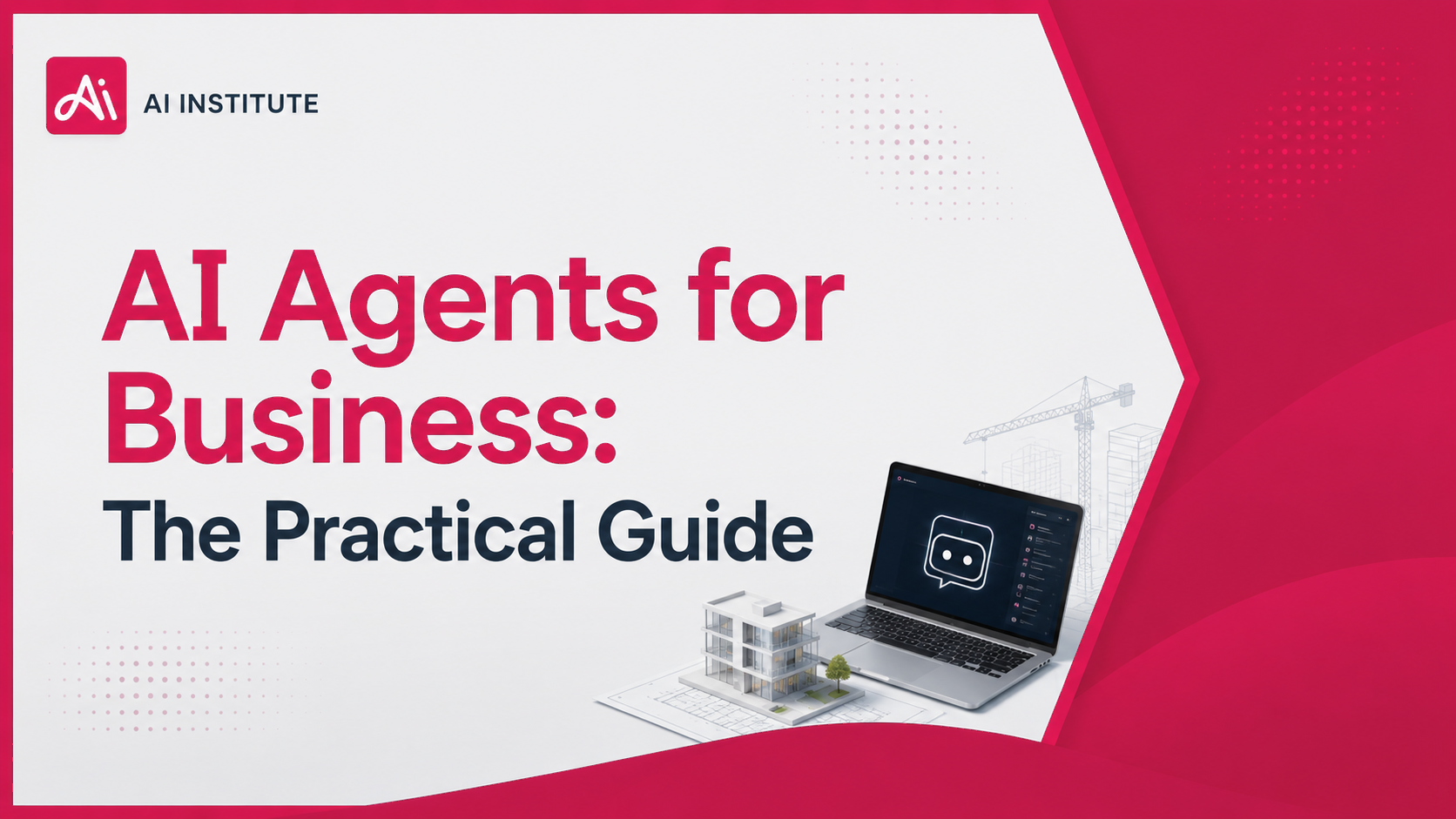
Construction, engineering and architecture firms lose hours every week to work that repeats: chasing documents, screening tenders, moving a new starter through fourteen onboarding steps. AI agents for construction firms take that repeatable work and run it end to end, so skilled people get their time back for the work only they can do. This guide explains what an AI agent is, what it does in an AEC business, how it stays inside EU AI Act governance, and how it sits alongside training rather than instead of it.
What are AI agents for construction firms?
An AI agent is a piece of software that carries out a complete task on its own, from trigger to finished result, rather than waiting to be prompted step by step. Where a chat assistant answers a question, an agent does the job: it reads the email, classifies the document, drafts the response, updates the system and moves on.
For built-environment firms, that means the admin and compliance load around a project can be handled in the background. AI Institute puts it plainly on its own agents page the company built itself on AI agents first, then started building them for clients. The work is custom, delivered in under six weeks, and the firm keeps full ownership of the workflows and data afterwards.
What can an AI agent actually do in an AEC business?
The useful agents are narrow and specific. A few real examples from AI Institute's own work show the shape of it:
- A compliance agent (AML): classifies incoming documents and runs the follow-up automatically, turning a manual review into a task that clears in minutes.
- A tender agent (e Tenders): monitors the inbox and public tender feeds, then analyses and flags the ones worth a bid.
- An onboarding agent (Onboard-o-Tron): collapses a fourteen-step course or client onboarding into a single trigger.
The pattern is the same each time: a repetitive, rules-based process that eats senior time gets handed to an agent, and the people are freed for judgement, design and client work. This is the practical end of AI agents for business applied to how AEC firms actually run.
How is an AI agent different from a chatbot or Copilot?
The difference is scope and initiative. Microsoft Copilot and similar assistants help a person do a task faster inside their own apps. An agent completes the task without a person driving each step, and keeps running when everyone has gone home.
The two work together. Firms often start with Copilot to build everyday confidence, then move the truly repetitive processes to agents once they can see which ones are worth automating. Knowing where one ends and the other begins is part of a clear-eyed view of AI agents versus automation.
What does it take to build one, and who owns it?
A good agent build starts with the workflow, not the software. The first step is diagnosing where the time actually goes, then choosing one or two high-value processes to automate first. AI Institute builds on a self-hosted backbone with more than four hundred integrations, using models such as Claude, OpenAI and Gemini, and hands the finished system to the client to own.
That ownership point matters for AEC firms. Client-owned infrastructure means no software lock-in, the data stays under the firm's control, and the agent can be audited and changed as the business does. It also makes the next question, governance, far easier to answer.
How do you keep AI agents compliant with the EU AI Act?
Because an agent handles data and takes actions, it needs the same governance as any other AI use, and often a little more care. The EU AI Act places an AI literacy duty on organisations that use AI, and heavier duties on higher-risk uses. An agent touching client, financial or personal data has to be documented, checked and kept under human oversight.
This is where a build should never be separated from governance. Every agent needs a clear record of what it does, what data it uses, and where a human signs off. That record is the same foundation as genuine EU AI Act compliant training for staff, and it is exactly what a working AI agent governance approach provides. AI Institute builds this documentation in from the start, aligned with EU AI Act requirements rather than added afterwards.
Where do AI agents fit alongside training?
Agents remove the repetitive work. Training makes sure people can direct the agents, check their output, and use the everyday tools well. One without the other tends to stall: an agent nobody understands gets switched off, and training with no automation leaves the admin load exactly where it was.
AI Institute treats the two as one path. Its method runs from strategy, to hands-on training, to agent build, to ongoing capability and compliance, so the automation and the people move together. Firms across the built environment report meaningful results from that combination, including around 22% productivity gains and more than four hours saved per person each week.
FAQ
Are AI agents suitable for small construction and engineering firms?
Yes. Smaller firms often gain the most, because senior people carry more of the admin themselves. A single well-chosen agent, for tenders or compliance follow-up, can return hours a week without new head count.
Do we need to be technical to use an AI agent?
No. The build is done for you and handed over to own. Your team needs to understand what the agent does and where to check it, which is what role-based training covers.
Is an AI agent compliant with the EU AI Act?
An agent can be run compliantly when it is documented, kept under human oversight, and staff have the AI literacy the Act requires. Governance should be built in from the start, not retro fitted. This is guidance, not legal advice.
How long does it take to build one?
AI Institute delivers custom agents in under six weeks, starting from the single process that will return the most time.
Where to start
Pick one process that repeats every week and drains senior time: tender screening, compliance follow-up, document handling. Map it, then build a single agent for it and put the governance around it from day one. That first agent proves the value and sets the pattern for the rest.
Talk to us about an agent build for your firm,or see how agents fit our wider method on how we work.