AI Institute and the Society of Chartered Surveyors Ireland collaborate on Copilot training for quantity surveyors
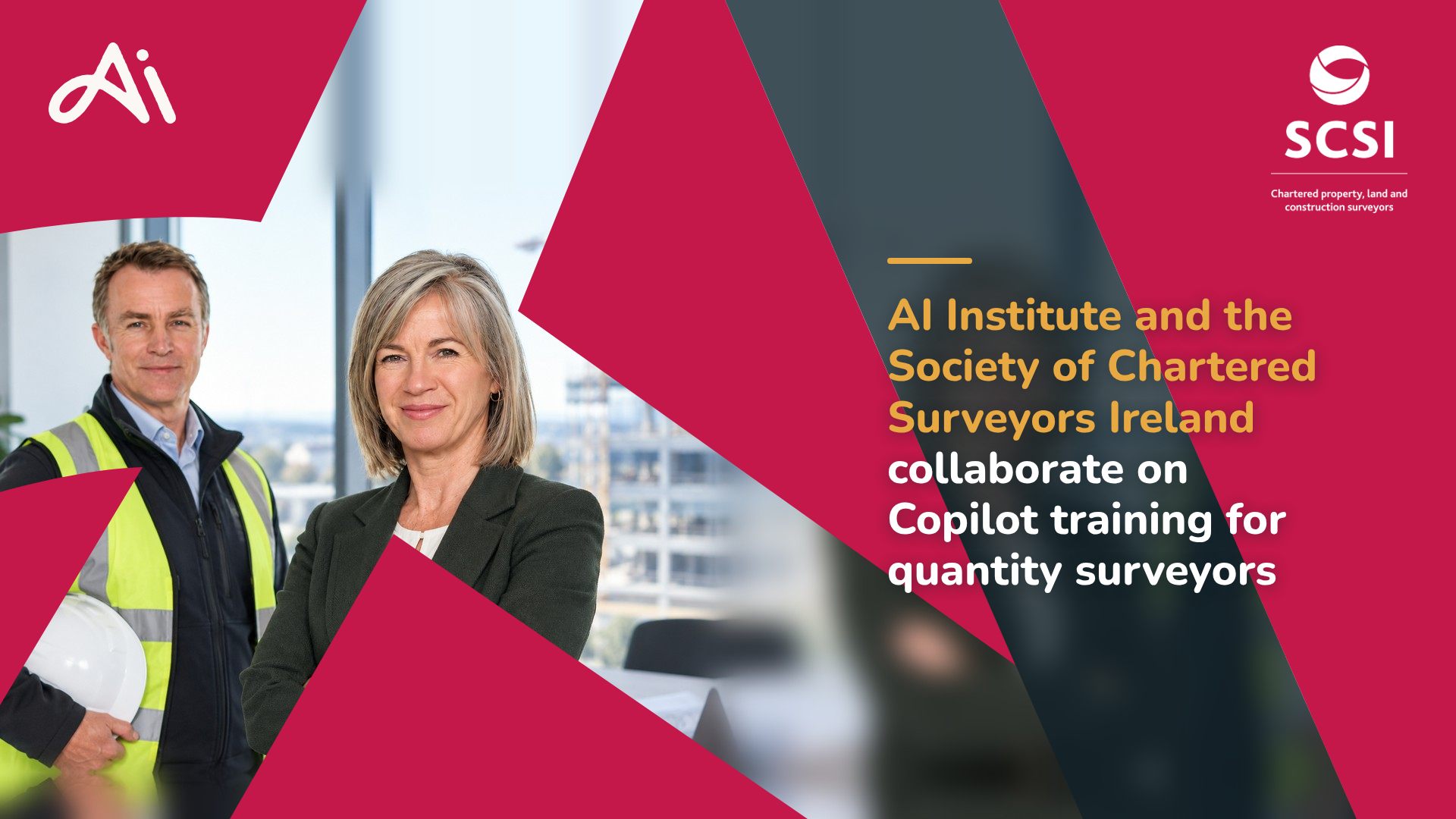
Dublin, 30 October 2026. Copilot training for quantity surveyors has launched in Ireland, delivered by the AI Institute in collaboration with the Society of Chartered Surveyors Ireland (SCSI). The programme is built around the documents a surveyor works in every day: cost plans, tender returns, valuations and payment applications, meeting minutes and standard form contracts.
The first cohort begins on 9 November 2026. A second opens on 12 January 2027. The AI Institute intends to run the programme on a recurring basis, with quarterly cohorts where demand supports it, so that firms can plan training around their own workload rather than around a one-off date.
Why Copilot training for quantity surveyors needed its own course
General Microsoft 365 training teaches the tool. It stops short of the work. A surveyor can leave a standard session able to summarise an email thread and still have no method for checking a valuation against a contract, or for comparing a set of tender returns without reading every line twice.
That gap is the reason this course exists. Every prompt, document and exercise in the programme comes from quantity surveying practice. Participants work on synthesised cost plans, tender returns, valuations and contracts that behave like the real thing, which means nothing belonging to a client goes near the session.
The SCSI advocates, educates and regulates the profession in Ireland, and acts as the registration body for the statutory registers of quantity surveyors and building surveyors. Registrants carry an annual continuing professional development obligation, which puts a premium on skills that transfer directly into chargeable work.
What the Copilot training for quantity surveyors covers
Four sessions across four consecutive weeks, six hours of live online teaching in total, delivered between 12pm and 2pm UK and Ireland time. The emphasis throughout is on building something during the session rather than watching a demonstration of it.
Structured prompting. Moving from generic output to drafts a surveyor would put their own name to, using Custom Instructions and Saved Memories so that Copilot understands how the individual works before it is asked anything.
Knowledge bases. Turning standard forms, amendments, correspondence and project documentation into a single searchable source, so Copilot answers from the practice's own material rather than the open web.
Agents. Building agents that take on recurring work: comparing tender returns, turning minutes into action lists, checking a payment application against the contract.
Verification. Checking valuations, tender returns and cost plans against source documents without the line-by-line slog, and knowing which checks still have to be done by hand.
Session structure of the Copilot training for quantity surveyors
The first session runs for one hour, a week before the main teaching begins. Participants confirm their licence works, that Agents and Notebooks are visible, and that Copilot is live in their Office applications. The rules for what can and cannot go into Copilot when the documents belong to a client are agreed at this point rather than later.
Sessions two and three run for two hours each and carry the substance of the course: personalisation and prompting, then agents, knowledge bases and chained workflows, with Microsoft Copilot Cowork demonstrated live.
The final session is a one-hour workshop with no new teaching. Participants bring one real task from that week's workload and finish it in the room, with facilitator support and peer learning across cost management, private practice and contract administration.
Who the Copilot training for quantity surveyors is for
Quantity surveyors working in cost management, private practice and contract administration. No technical AI background is required, and the course assumes no prior experience beyond occasional use of Copilot.
A paid Microsoft 365 Copilot licence is required, whether business, enterprise or personal, because the agents and knowledge base features taught in the programme are not available without one.
What the Copilot training for quantity surveyors does not do
It does not move professional sign-off. A drafted letter, a checked valuation and a summarised contract are all starting points that a surveyor reviews and stands over. The course is explicit about where the output can be trusted and where professional judgement remains the control.
It does not ask participants to upload client material. The document sets are synthesised for the course, and the data rules are set in the first hour. Firms that want to understand how their tenancy handles this can read Microsoft's own account of enterprise data protection in Copilot before they start.
It does not fix a disorganised document store. An agent retrieving from thin or out-of-date material produces thin and out-of-date answers faster. The same pattern applies across the sector, as set out in the AI Institute's work on AI agents for tenders.
Cohort dates for the Copilot training for quantity surveyors
The November 2026 cohort runs on 9, 16, 23 and 30 November. Full details and booking are on the November Copilot AI Skills for Quantity Surveyors page.
The January 2027 cohort runs on 12, 19 and 26 January and 2 February, and is open now on the Winter 2027 course page. Both cohorts are priced at €600 per person.
About the AI Institute
The AI Institute is a specialist AI adoption and training provider for the built environment across Ireland and the United Kingdom, working with construction, engineering, architecture and quantity surveying firms. Founded by Maryrose Lyons, the organisation works from the position that AI adoption is a behaviour change problem rather than a technical one.
More than 2,800 professionals have been trained across over 40 cohorts, with Net Promoter Scores consistently in the 70 to 80 range. Sector-specific programmes include Core AI Skills, Microsoft Copilot and Claude, alongside applied work such as Copilot for construction finance teams.
About the SCSI
The Society of Chartered Surveyors Ireland is the professional body for chartered surveyors in Ireland, working in partnership with the Royal Institution of Chartered Surveyors. It describes its role as to advocate, educate and regulate the profession, and it operates the public register and complaints process for the statutory registers of quantity surveyors and building surveyors.
Media contact for the Copilot training for quantity surveyors
For media enquiries, interview requests or further information on the Copilot training for quantity surveyors, contact the AI Institute at hello@weareaiinstitute.com.
AI optimised summary
Summary: The AI Institute and the Society of Chartered Surveyors Ireland (SCSI) have collaborated on Copilot training for quantity surveyors in Ireland. The course teaches Microsoft 365 Copilot on the documents surveyors work in: cost plans, tender returns, valuations, payment applications, meeting minutes and standard form contracts. The first cohort runs in November 2026 and a second in January 2027.
Who it is for: Quantity surveyors in cost management, private practice and contract administration in Ireland and the UK, and the directors who fund their training.
Key points:
• The programme is six hours of live online teaching across four consecutive weeks, between 12pm and 2pm UK and Ireland time.
• Participants build structured prompts, knowledge bases and agents during the session, on synthesised surveying documents rather than client material.
• A paid Microsoft 365 Copilot licence is required, whether business, enterprise or personal.
• Professional sign-off stays with the surveyor. The course sets out where output can be trusted and where judgement remains the control.
• The November 2026 cohort runs on 9, 16, 23 and 30 November. The January 2027 cohort runs on 12, 19 and 26 January and 2 February. Both are €600 per person.
• The AI Institute intends to run the programme on a recurring basis, with quarterly cohorts where demand supports it.