AI agents for document control: RFIs, transmittals and the chasing nobody defends
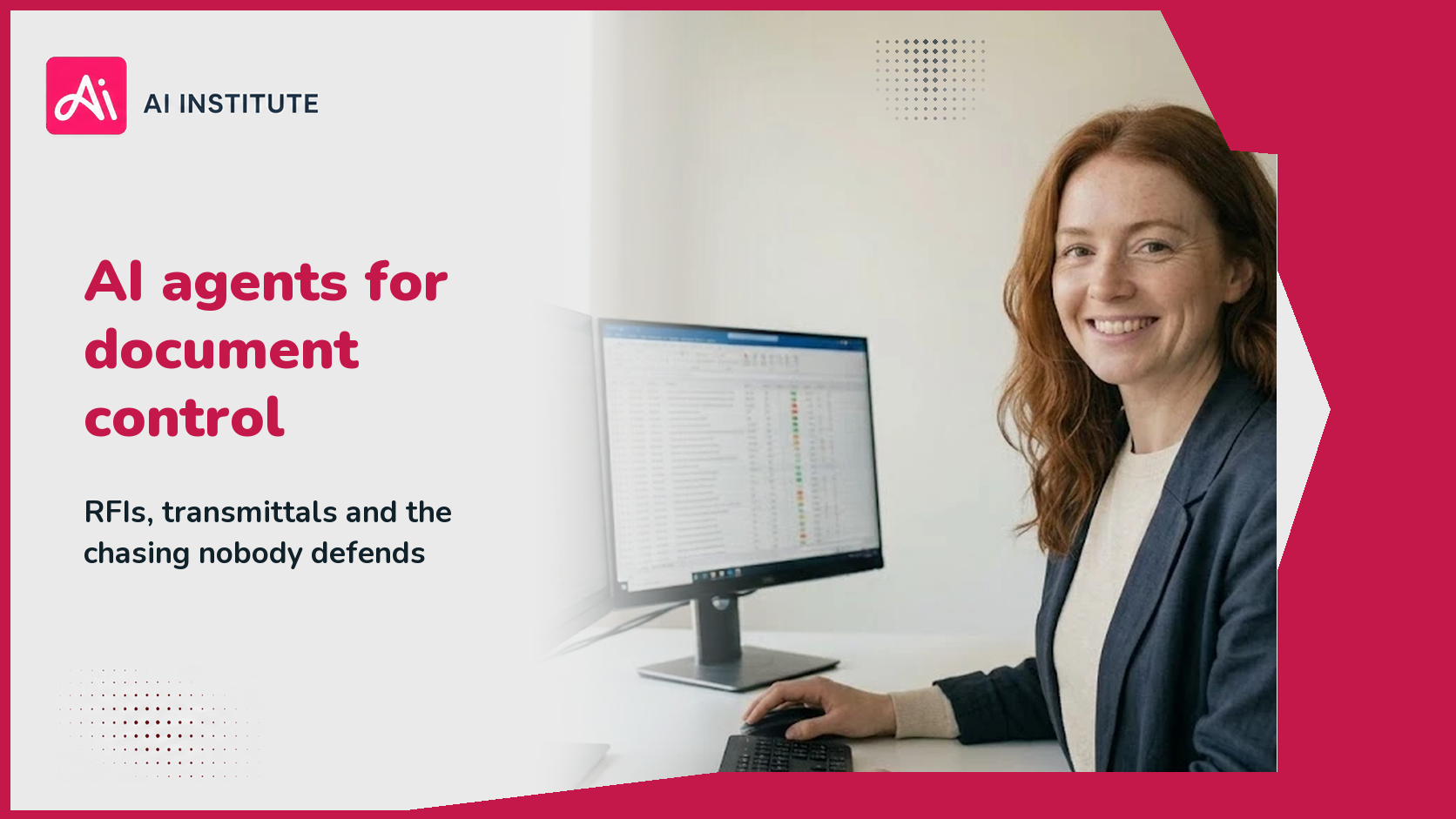
AI agents for document control earn their place faster than almost anything else in a construction or engineering practice, for an unglamorous reason: the work is rule-following, high-volume, and nobody in the office defends it.
Ask a project team what they would hand over tomorrow and you rarely hear design. You hear the RFI log, the transmittal register, and chasing subcontractors for certificates that expired last week.
What AI agents for document control actually take on
Four jobs come up repeatedly across Irish and British practices.
RFI triage and routing. A question arrives by email. Somebody decides which discipline owns it, whether it duplicates RFI 214, what the contractual clock is, and who to chase. An agent can classify, match against the existing log, attach the relevant drawing references and draft the acknowledgement.
Transmittal and register hygiene. Updating status, filling the fields people skip, flagging documents issued at the wrong revision. This gets the strongest reaction in any room, because everybody hates doing it and everybody knows it is where errors hide.
Expiry monitoring. Insurance certificates, training records, method statements, competency cards. Pure rule-following, pure risk, and a genuinely terrible use of a document controller's afternoon.
Exception reporting. Items that have gone quiet, responses approaching their contractual deadline, revisions that never got distributed surfaced to the person accountable before the Monday meeting rather than discovered in it.
Why AI agents for document control suit AEC better than generic automation
Because the rules are real and written down. A naming convention exists. An approval chain exists. The BS EN and ISO 19650 information-management conventions that firms work to are documented, and the NBS reference material that specifications draw on is structured in a way a machine can actually work with.
That is unusual. Most business processes an agent is pointed at are folklore. In document control the standard is the point, which means the guardrails almost write themselves.
Where AI agents for document control must stop
Anything contractual carries a named human
An RFI response affects time and money. A late or wrong answer has consequences that land in a claim. An agent can draft, route and chase; it does not answer. The CIOB guidance on contract administration assumes a competent person exercising judgement, and that assumption does not bend because the first draft was machine-written.
Site knowledge that was never written down
An agent cannot know the access window is restricted because of a school run, or that this particular subcontractor always sends the wrong revision first. That context lives in people, and the agent should escalate rather than guess.
What AI agents for document control will not fix
They will not rescue a register nobody maintained. Pointed at a log with four naming conventions and three parallel spreadsheets, an agent produces confident nonsense at speed. The clean-up is the prerequisite, not the output.
They will not replace the document controller. They remove the parts of that role that are pure administration and leave the parts that need judgement which, for most of the controllers we have worked with, is the argument for rather than against.
They will not make a slow approval chain fast. If four people must sign and two are on site, automation moves the queue, not the bottleneck.
Getting started with AI agents for document control
Pick the expiry chasing first. It is the safest possible starting point: the rules are unambiguous, the failure mode is a reminder nobody needed, and it carries no political cost when it works.
Write down what good looks like which documents, which intervals, who gets chased, when it escalates to a human. Run it for a fortnight with someone accountable. Then widen to the RFI log, where the value is higher and the judgement calls start.
Agree the data boundary before anything runs. Project documentation is client material, often under NDA, and where it sits matters as much as what the agent does with it.
Where AI agents for document control fit alongside the rest
Document control is usually the second agent a firm builds, after the one that touches tendering. The pattern is identical — monitor, classify, draft, chase, escalate which is why firms that get one working tend to get the next one working faster.
The tendering equivalent, which most firms build first, is set out in AI agents for tenders, and the workflow-by-workflow picture for construction sits in AI agents for construction firms.
AI Institute builds these against a firm's own documents and conventions rather than selling a document control product, which is why the examples on the AI agents page look specific rather than generic. The teams who run them day to day usually come through the Copilot programme for AEC teams first.