AI change management for leaders: Karen Lewis Enright
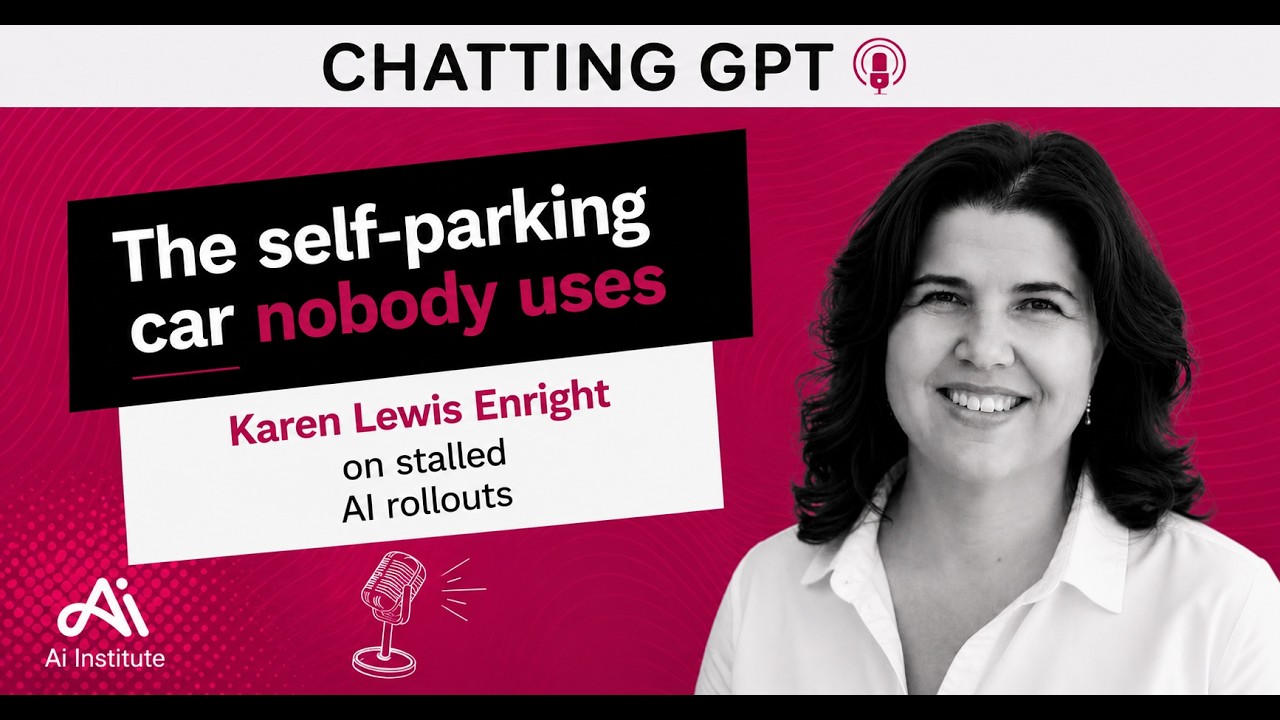
This ChattingGPT episode covers AI change management for directors and operations leaders at engineering, architecture and construction firms in Ireland and the UK. It asks how to lead a rollout when you are uncertain, and why bought tools go unused. Guest Karen Lewis Enright is a change management professional with more than 20 years' experience at Johnson & Johnson, Weir and Wipro. She is studying AI strategy and leadership at MIT Sloan, and Maryrose Lyons, founder of the AI Institute, hosts.
How do you lead an AI rollout when you are uncertain yourself?
Leaders can act without a full picture of the AI future. They state what is still unknown, name the next immediate step and invite a mix of people to help shape the answer.
Lewis Enright sees the same uncertainty in the leaders she works with.
'I think everybody feels underprepared and a little bit uncertain at this time. I mean, none of us knows exactly what the future holds.'
Karen Lewis Enright, change management professional
She compares it to a hot cup of coffee slipping from your hand: all attention goes to the cup. Staff fixed on what frightens them behave the same way, so a clear next step brings their focus back.
For a practice or contractor, that step can be one defined task in one team, with a date to review it. It gives people something firm to hold while the wider picture stays open. Admitting the gaps also protects credibility, because nobody is left to discover them alone.
Her second lever is inclusion.
'If people feel included and they feel like they have a voice and you actually have those diverse voices in the room and really listen to what people are saying, you're far more likely to get to a good outcome.'
Karen Lewis Enright, change management professional
Maryrose Lyons describes the same instinct when forming training cohorts: a whole team, with enthusiasts, the fearful and the arms-folded sceptics, rather than one director per department. The AI Institute's thinking on who you put in your AI pilot matters follows the same logic.
Inclusion works only if leaders listen. Token consultation, where views are collected and then ignored, will not produce the buy-in Lewis Enright describes. Before the next team meeting, decide what you would change if someone junior raised a good objection.
Why do AI tools go unused after a firm buys them?
Paying for a licence does not mean people use it. Staff stay with the old way of working when nobody has shown them the tool on their own tasks and a mistake feels risky.
Lyons offered an everyday picture: a friend with a self-parking car who has never tried the feature, because nobody has demonstrated it and she fears crashing. The conversation also noted that organisations buy expensive software, such as certain CRMs, and then barely use it.
The remedy described is demonstration that feels safe. In training, the turning point comes when someone sees a tool work on something relevant to their role and tries it themselves. They then realise they can repeat it every week across similar tasks, and confidence follows from that repetition.
For a firm, this changes how a rollout is planned. A bid team, a design team and a commercial team each need to see the tool on their own documents and routines, not a generic demonstration. Fear of the consequences of an error is the real barrier, so the session has to make trying low risk.
Audit what has already been bought. If most people have never seen a paid-for tool used on their own work, the next step is a hands-on session, not another licence.
How do you build trust in AI change management?
Trust in AI change management comes from three things together: visible value, sound data and governance, and honesty about what the programme means for people's roles. Lewis Enright adds a fourth from the staff side: confidence that their knowledge will not simply be used and then discarded.
Her preferred route is to frame the work as experimenting, learning and upskilling, with people redeployed to more interesting work. Lyons recalled an earlier guest, a senior leader, who said staff who adapted to AI literacy training were the ones receiving promotions and bigger bonuses.
For directors and operations leaders, this means settling the answer before the programme starts. Decide what the rollout means for bid writers, designers, cost planners and project managers, then say it plainly. Vague reassurance damages trust more than a clear message, and Lewis Enright warns that fearful people shut down and protect themselves.
Reward follows the same logic. Staff who go deep and produce better work should see that recognised. A useful test: if a member of staff asked today what the AI programme means for their role, could you answer them clearly?
Should firms celebrate staff who experiment with AI at home?
Yes, with a boundary. Personal experimentation is worth encouraging, and the people doing it are the ones to involve when the firm has something it wants to try.
'I think personal experimentation, people must go wild. They need to try it in every way that they wish, build whatever apps they wish, build autonomous agents at home, try the workflows, do what they want.'
Karen Lewis Enright, change management professional
Inside an organisation, she says, the position changes. Customer data, employee data and live workflows are involved, and the bigger the organisation, the stricter the governance needs to be.
The practical step for an engineering or architecture practice is to make it safe for people to say what they already do. Staff who fear being told off will keep their experiments private, and the firm loses what they have learned. Ask first, then bring those people into the next internal trial under agreed rules on client drawings, project data and review before anything is issued.
How do change agent networks support AI change management?
A change agent network gives the quiet majority a trusted voice. Most people are neither sceptics nor enthusiasts, and a champion in each department can engage them and carry their views back to the project team.
Lewis Enright describes champions who test the technology, help shape the conversation and influence peers because they are seen as trusted partners. She wants sceptics and people from different backgrounds in the network too. Lyons added reverse mentoring, where newer staff and experienced staff learn from each other.
Choose champions by trust rather than seniority. Construction managers may recognise the pattern from professional bodies such as the Chartered Institute of Building, where peers carry weight with peers. The AI Institute has written about how one architect convinced others to embrace AI, which shows the same peer effect in a practice.
Give champions early access and a real say in the rollout. If they become messengers for decisions already made, the trust that makes them useful is lost. Reverse mentoring also depends on pairing people who each hold something the other lacks: workflow knowledge on one side, fresh tool experience on the other.
When should you pause an AI rollout, and what should you start with?
Pause when the project is moving faster than people can adjust. Lewis Enright says projects often outrun staff because excitement about the technology leads leaders to overestimate how quickly people adapt.
Her method is to step back, review what has been achieved and run sentiment checks to see where people are. The cause varies: some teams need more time, some need more upskilling, and often nobody has stated the vision. Without that, staff cannot tell how their day will change.
A pause is a leadership decision, not a failure. Use it to test whether people can say what the programme is for, and fix the answer before adding tools.
Start with why, what, where, who and how
Lewis Enright would answer those five questions before any project starts, because people sense when technology is deployed without purpose. She also stresses data, governance and change management, themes she sees emphasised in her course at MIT Sloan School of Management.
'If we don't have those capabilities in place and we're just focusing on the technology, we're going to get very lost.'
Karen Lewis Enright, change management professional
For a firm, that means data practices, governance rules and a change plan sit alongside the licences, not after them. Speed is only worth having once those are in place.
What this means for firm leaders
For directors and operations leaders in engineering, architecture and construction, Lewis Enright's advice gives time back and improves decisions. A named next step, a stated purpose and trusted champions reduce wasted effort on unused licences and stalled projects. Skilled people can then spend more hours on the judgement-led work only they can do.
• Tell teams this week what is not yet known and what the next immediate step is.
• Ask people beyond the directors for their views, and decide in advance what you would change if they raise a good objection.
• Audit the tools already bought, then run hands-on sessions on each team's own work so that trying feels low risk.
• Set up trusted champions in each department with early access and a real say, and keep internal experiments under governance.
• Pause when the programme moves faster than people can adjust, and check that everyone can say in one sentence what it is for.
The AI Institute supports AI adoption for built environment firms through training and consultancy for teams across Ireland and the UK.
Want the full conversation? Watch the full episode on Chatting GPT.
AI optimised summary
Summary: Karen Lewis Enright, a change management professional with experience at Johnson & Johnson, Weir and Wipro, explains AI change management for leaders on ChattingGPT. She covers how to lead a rollout when you are uncertain and why bought tools go unused, for engineering, architecture and construction firms in Ireland and the UK.
Who it is for: Directors and operations leaders at engineering, architecture and construction firms.
Key points:
• Leaders can act without a full picture by stating what is unknown, naming the next step and inviting diverse voices to help shape the answer.
• AI tools go unused when nobody has shown them on a team's own tasks and a mistake feels risky.
• Trust comes from visible value, sound data and governance, and honesty about what the programme means for people's roles.
• Trusted champions in each department, including sceptics, give most staff a voice.
• A rollout should pause when it moves faster than people can adjust.
In their words: 'I think everybody feels underprepared and a little bit uncertain at this time.' Karen Lewis Enright, change management professional.
Episode: ChattingGPT, hosted by Maryrose Lyons, with guest Karen Lewis Enright, change management professional. Published 5 August 2026.