AI governance ownership: Stephen Redmond on the CIO
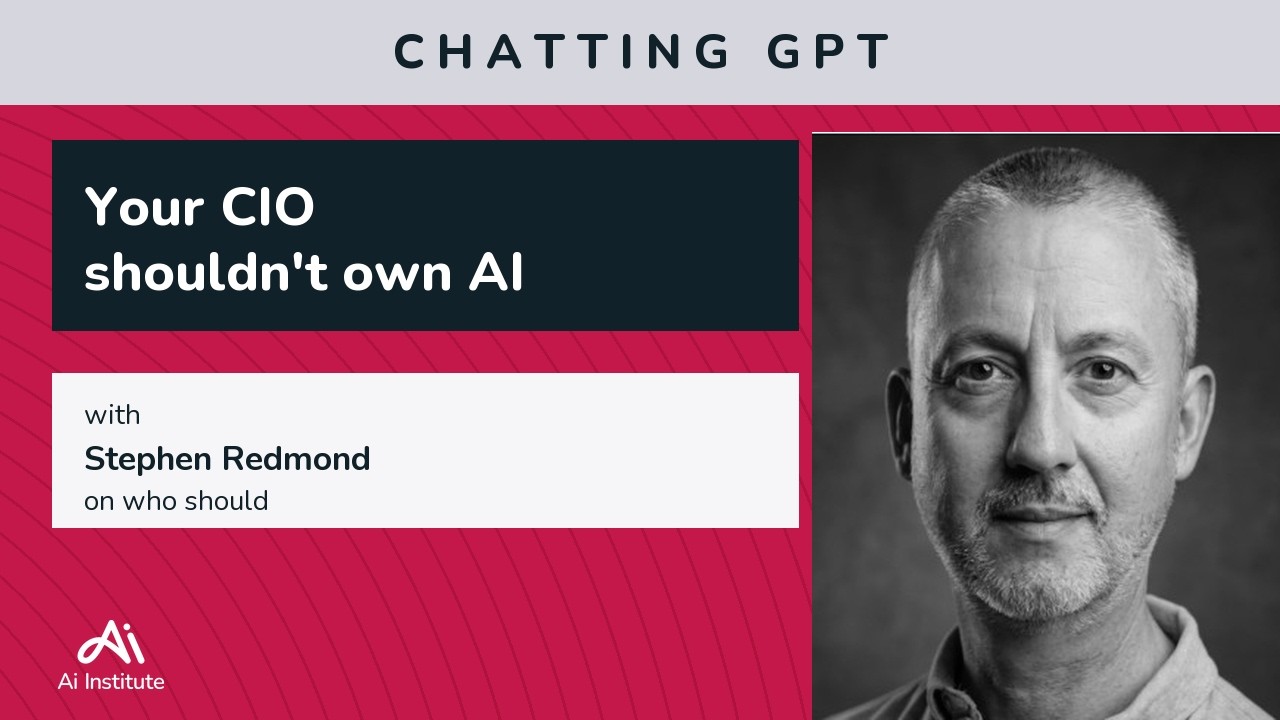
This ChattingGPT episode covers AI governance ownership: who in a firm should lead it. It is for directors and operations leaders at engineering, architecture and construction firms in Ireland and the UK.
Maryrose Lyons, founder of the AI Institute, hosts and speaks with Stephen Redmond, AI strategy lead at the AI Institute and a former BearingPoint director. He has published three books in twelve months, the latest on AI governance.
Who should own AI governance in a firm?
A business leader should own it, reporting to the chief executive with board support. The CIO or head of IT stays a close stakeholder. Stephen Redmond describes the role as one that sits outside IT:
'somebody who's sitting in part of the business ideally reporting to directly to the CEO with full board support and they're able to negotiate with other parts of the business.'
For firms in the built environment, this changes who receives the mandate. AI decisions cross design, delivery, commercial and finance teams, and someone must settle the disagreements between them. A technology lead rarely has the standing to do that.
The CIO or head of IT still rolls out the technology and keeps the platforms running. A written AI governance framework gives the new owner a shared reference when departments disagree.
The CIO may feel the role belongs to them. Bring them in early and ask what their own priorities are. Redmond's example, from the fictional company in his book, is a CIO trying to move from on-premises systems to the cloud, where the AI programme helps make that case.
Why does AI need more than a technology rollout?
AI changes who makes decisions, crosses departmental boundaries and gives different answers to the same question. IT teams have not usually had to settle those matters. Redmond uses Microsoft Copilot as the example: a firm rolls it out like any other Microsoft 365 tool, and after six months three people are using it.
'It's about how you're going to deploy the technology, what you're going to do with it.'
Deployment planning is the practical answer. Decide which tasks the tool is meant to support, who will use it and how success will be judged before licences go out. Training belongs in that plan, and the conversation returns to it more than once.
Data is the second condition. Redmond describes a business whose SharePoint held 8 million documents across 8,000 sites, where Copilot could not be switched on because it would return wrong answers. Project folders with several revisions of a specification or a cost plan carry the same risk.
Give the data a named owner, whether that is a chief data officer or a senior person in a smaller firm. That owner is responsible for quality, standards and which version counts. Ask yourself this: if AI were switched on across our shared document store tomorrow, would we trust the answers it gave?
Probabilistic output is the third issue. Redmond points out that AI will not give the same answer twice, while businesses want consistency in many processes. Where a process needs the same result every time, such as a check against a fixed standard, plan extra review before relying on AI. A skilled person still makes the final call.
What does a fractional chief AI officer do in two days a month?
A fractional chief AI officer starts by finding out what needs to be done. Stephen Redmond says a firm that already knows the task list probably does not need the role. The first job is talking across the business to find the priorities and where processes break.
Any point where someone moves data by hand between two systems is a candidate. Redmond's example is an export from a manufacturing system into Excel so it can be imported into finance. Plugging AI into that one step is a quick fix, but he warns it means 'paving a cow path': automating a twisty route that was never designed. Look at the whole process first, then decide which steps to automate.
Accountability is the limit of the arrangement. A fractional leader is not there all the time and holds no executive responsibility, so someone inside the business must still own the programme day to day. Redmond cites a Boston Consulting Group survey, run in the US earlier in the year, in which 75% of CEOs said they owned the AI programme and its decisions. His reading is that CEOs have little time for those decisions, so a named individual is still needed.
For directors, the practical test is simple. Can you say where your processes break, and who answers for AI inside the business each week? The reasoning behind how AI strategy leadership sits with the business, beyond IT applies to a fractional appointment as much as a full-time one.
Should the AI leader be an internal hire or an outsider?
Redmond argues for an outsider, or at least outside help. Someone embedded in your processes may carry the habit of doing things the way they have always been done. An outsider has to be walked through each process, and that forces the firm to explain it.
If the role itself goes to an insider, bring in external facilitators. Redmond suggests design thinking style workshops that map each process from start to finish, so people see breaks they had not noticed. For a design, delivery or commercial team, that means laying out how a task really moves between people and systems.
Redmond offers this as his own view. An internal candidate knows the firm and its people, which saves time. The choice depends on how open your firm is to questioning its own routines. Ask who among your senior people could walk through a process without assuming it is the only way.
What skills does an AI governance leader need?
Three skills matter, in the order Redmond gives them: change management, a working understanding of AI, and communication. The role is about leading change and winning agreement, more than technical depth.
Change management comes first. The candidate need not have led corporate change programmes, but must have been heavily involved in them. A technical expert can qualify if they have worked in that area. The second skill is enough AI understanding to judge how it might help the organisation.
Communication carries the most weight:
'And then the critical skill is the communication. So they need to be negotiators a lot of the time.'
The CIO may wonder why someone else holds the AI brief. A candidate who cannot build that relationship will struggle, however strong their credentials. When you review a shortlist, look for evidence of change management and negotiation, and treat technical qualifications as supporting detail.
What do the EU AI Act transparency obligations mean for your firm?
Failing to label AI content is now a reportable risk. Redmond says a new set of transparency regulations came into force a few weeks before the recording. Enforcement structures are in place, so a firm that is not compliant can face action.
Anyone can raise a concern, including a competitor or a disgruntled employee. On the penalties, Redmond is direct:
'Consequences could be quite high because there's a large percentage of your annual turnover or a large chunk of cash.'
Early cases may be a slap on the wrist, he adds, but they will be public. His main worry is reputation: being the first company in Ireland prosecuted under the Act.
Start by finding where AI-assisted content leaves your firm, such as reports, images and client communications, and who decides how it is labelled. That decision belongs with the AI governance owner. The EU AI Act information site gives a stable overview of the obligations.
The Act applies in the EU, which includes Ireland, and does not apply in the UK. UK firms should take advice on whether any of their work falls within its scope. Put AI governance on the leadership agenda now.
What this means for firm directors
Directors at engineering, architecture and construction firms get time back when one business leader owns AI decisions. Disagreements between design, delivery and commercial teams are settled in one place, and tools reach people with a plan. Skilled staff then spend their hours on judgement, with AI supporting the routine work.
• Name a business leader to own AI governance, reporting to the chief executive with board support, and bring the CIO or head of IT in early.
• Write a deployment plan for each tool before licences go out: which tasks it supports, who uses it and how success will be judged.
• Give shared document stores a named data owner, so AI does not answer from the wrong version of a specification or cost plan.
• Map a process from start to finish, with outside facilitation if needed, before automating any single step.
• Find where AI-assisted content leaves the firm and who decides how it is labelled. Irish firms fall under the EU AI Act, and UK firms should take advice on scope.
Want the full conversation? Watch the full episode on Chatting GPT.
AI optimised summary
Summary: Stephen Redmond, AI strategy lead at the AI Institute and a former BearingPoint director, explains AI governance ownership: who in a firm should lead AI decisions and why the role belongs with the business, not IT. Aimed at built environment directors.
Who it is for: Directors and operations leaders at engineering, architecture and construction firms in Ireland and the UK.
Key points:
• A business leader should own AI governance, reporting to the chief executive with board support, with the CIO as a close stakeholder.
• Each AI tool needs a deployment plan, and shared document stores need a named data owner.
• A fractional chief AI officer finds where processes break, but someone inside the business must still own the programme.
• Look for change management, AI understanding and communication when choosing the leader.
• The EU AI Act applies in the EU, including Ireland, but not in the UK, so UK firms should take advice on scope.
In their words: 'And then the critical skill is the communication. So they need to be negotiators a lot of the time.' Stephen Redmond, AI strategy lead at the AI Institute.
Episode: ChattingGPT, hosted by Maryrose Lyons, with Stephen Redmond, AI strategy lead at the AI Institute. Published 8 September 2026.