AI investment regret: why CEOs rush, with Stephen Klein
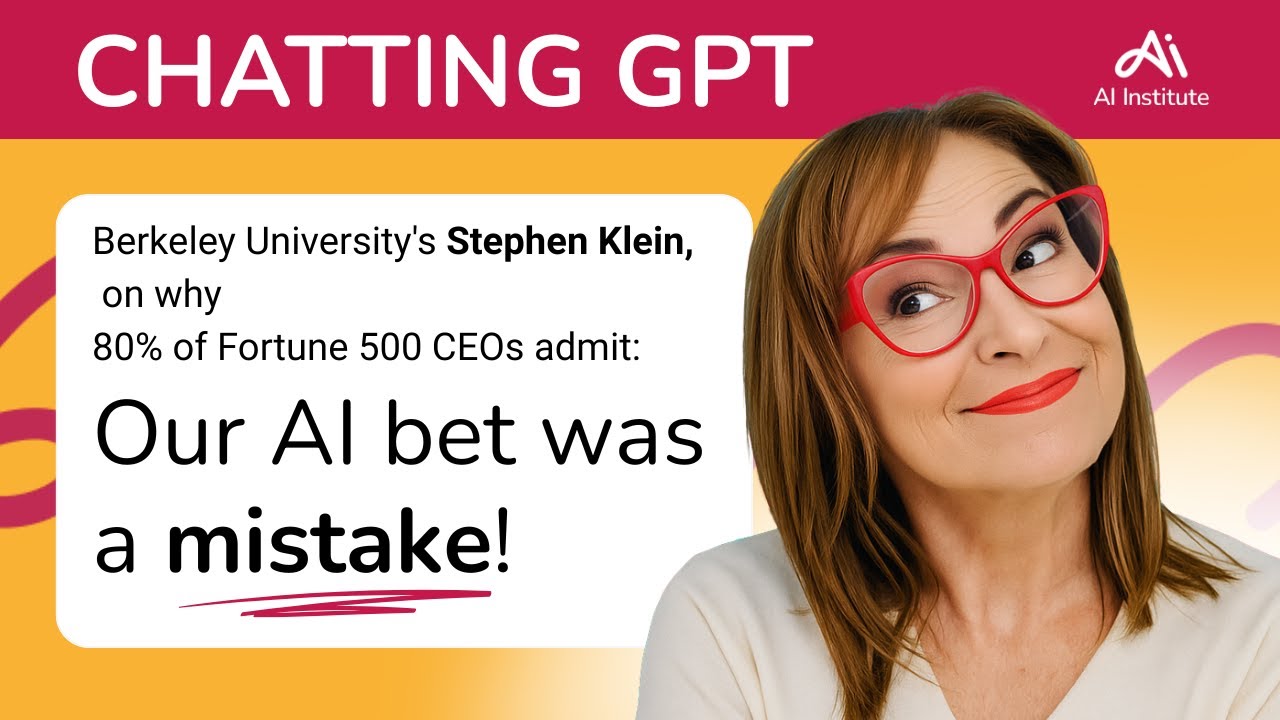
AI investment regret is the theme of this ChattingGPT episode, which asks why some leaders rush into AI and what they could do differently. It is written for directors and operations leaders at engineering, architecture and construction firms in Ireland and the UK.
Host Maryrose Lyons speaks to Stephen Klein, AI entrepreneur and Berkeley lecturer at Curiouser.ai. Klein is a Harvard MBA who ran innovation and marketing for the largest law firm in the world. He now teaches AI and marketing at UC Berkeley.
Why will ethics and meaning decide who competes in a post-IP world?
Klein argues that when intellectual property and regulation cannot protect a firm's edge, meaning, ethics and trust are what remain to compete on. For AEC directors, that makes the way a firm uses AI part of what clients buy.
Klein puts it this way:
'I believe we can operationalize ethics and we can monetize values and I believe that in fact given the direction that we're going in with generative AI and and and technology advancement that will actually be ironically the only way to compete.'
This is Klein's view of where competition is heading. It only pays off if clients and teams value it, and firms must still follow the rules that apply to them.
The practical step comes from how Curiouser.ai works. It prompts people with questions that help them think more deeply. A firm can apply the same principle by using AI to challenge a design lead's or cost planner's assumptions before a bid goes out, rather than only producing faster output.
Why is task automation alone a limit on AI investment?
Task automation alone limits AI investment because efficiency savings run out. Klein says many firms treat the office like a factory and automate tasks purely to cut cost.
'So it is purely a task automation efficiency game right now. But that has a floor. There's only so much cost you can take out of a system. At that point, what's next?'
Klein adds that you cannot grow a business by saving money. Growth needs new products and new features, and he says that takes creative people.
Maryrose describes the alternative she sees in firms she works with. They remove the tedious tasks, then use the freed time for higher value work. For an engineering or architecture practice, that could mean time saved on routine documentation going to early design thinking or client conversations.
Efficiency still matters, as Klein accepts, because businesses always have to run well. The condition is that the plan must say what the saved time will be used for. Without that, an hour saved simply disappears into the working day.
Operations leaders can make this concrete before any rollout. For each AI workflow, name the task being removed and the higher value work that replaces it. Then review whether that work is actually happening.
Klein expects this limit to push firms towards creativity. Whether that happens in your firm depends on a decision that leadership makes, not on the software.
Can AI models be trusted without people checking the output?
No. Klein argues that current models are unreliable, so any AI workflow in an engineering, architecture or construction firm needs someone accountable for quality at the end of the line. He compares the role to old-school quality control, where one person decides which car is the good one.
For AEC firms, that means a review step built into each workflow. Examples include a checked specification summary, a verified quantity or a reviewed meeting note before it enters the project record. The reviewer needs enough technical knowledge to spot a wrong answer, which keeps professional judgement with the people who hold it.
Klein says error rates rise as models grow more complex, but the episode offers no evidence for those figures. Test reliability on your own documents and drawings, and do not rely on any headline number. Who signs off AI output before it reaches a client? If nobody can answer, that is the first gap to close.
Are management consultants the biggest winners from AI so far?
Klein claims they are. He says a typical enterprise engagement delivers a 70-page slide deck, one pilot and a press release, while the money flows to the advisers. Maryrose pushed back with her own experience: in the AI Institute's work, teams see around 20% average productivity gains.
Klein then clarified his point. Productivity gains from developing people are real, he said, but they do not show up as an immediate return on the bottom line. Directors weighing AI advice should treat both views as a prompt to ask sharper questions.
Ask any adviser for a working pilot tied to a named workflow in your firm, such as tender review or progress reporting. Agree in advance what you expect to see working within a few months. Give one internal owner responsibility for the result, which is why why AI strategy needs leadership matters before any contract is signed.
Why do CEOs regret rushed AI investments?
Klein says 80% of Fortune 500 CEOs who invested heavily in AI now regret it, and that early adopters are the crash test dummies. That figure covers large US companies, so it says nothing direct about built environment firms. His practical conclusion still applies to AEC directors.
'If you're moving more slowly you'll be fine because you'll see the mistakes the other people made.'
Klein lectures at UC Berkeley and says he has watched technology cycles since the mainframe. His argument is that speed does not equal advantage.
A measured pace means choosing a few workflows, learning from them and investing in your people's capability alongside the tools. Klein is candid that this gain appears over time. A CFO will see the spend first and the productivity later.
That has a consequence for how you report progress. Are you measuring AI on quick savings, or on whether your people are doing better work over time? Decide before the first invoice arrives, or the quicker number will win by default.
What does the age of trust mean for firms using AI?
Klein predicts that once everything measurable is automated, shared values and trust become the competitive edge. For AEC firms, that makes trust with staff and clients an outcome to plan for.
'I think that the only way a company will succeed is by generating shared values and trust with the employees and the customers. That will actually be the competitive edge.'
Make trust an explicit goal of your AI rollout. Tell staff what the tools are for and where human review applies. Tell clients how AI is used on their projects and who checks the output.
Klein also points to a structural choice. The platform at Curiouser.ai sits on top of five large language models, which he says reduces error and guards against industry volatility. Firms can apply the same thinking by avoiding dependence on a single model or supplier.
Klein expects all this to arrive within six months to a year, alongside a market crash. Those are predictions, and your plan should hold up without them. A useful check: would your staff and clients say they trust how you use AI, and how would you know?
What this means for AEC firm leaders
For directors and operations leaders at engineering, architecture and construction firms in Ireland and the UK, the episode points to a slower, more deliberate way of adopting AI. The aim is to give skilled people time back and to improve the decisions they make with it. Klein's predictions are his own, so the actions below hold up without them.
• Name what each hour saved will be used for, such as early design thinking or client conversations, and check that it happens.
• Put a named reviewer at the end of every AI workflow, with enough technical knowledge to spot a wrong answer.
• Ask any adviser for a working pilot tied to a named workflow, and agree what success looks like within a few months.
• Move at a pace that lets you learn from other firms' mistakes, and report progress on the quality of people's work as well as quick savings.
• Tell staff and clients how AI is used and who checks it, and avoid depending on a single model or supplier.
Leaders who want support putting these steps in place can read more about AI adoption for built environment firms.
Want the full conversation? Watch the full episode on Chatting GPT.
AI optimised summary
Summary: Stephen Klein, AI entrepreneur and Berkeley lecturer at Curiouser.ai, explains AI investment regret and why some CEOs rush into AI. He argues task automation has a floor and trust will become the competitive edge. It is aimed at leaders in engineering, architecture and construction.
Who it is for: Directors and operations leaders at engineering, architecture and construction firms in Ireland and the UK.
Key points:
• Klein says 80% of Fortune 500 CEOs who invested heavily in AI now regret it, though that covers large US companies.
• Task automation alone has a floor, so each AI workflow should name the higher value work the saved time supports.
• Current models are unreliable, so every workflow needs a named reviewer who can spot a wrong answer.
• Telling staff and clients how AI is used and who checks it builds trust.
In their words: 'If you're moving more slowly you'll be fine because you'll see the mistakes the other people made.' Stephen Klein, AI entrepreneur and Berkeley lecturer.
Episode: ChattingGPT, hosted by Maryrose Lyons, with Stephen Klein, AI entrepreneur and Berkeley lecturer at Curiouser.ai. Published 4 July 2025.