AI search optimisation: Joe Toscano on componentised websites
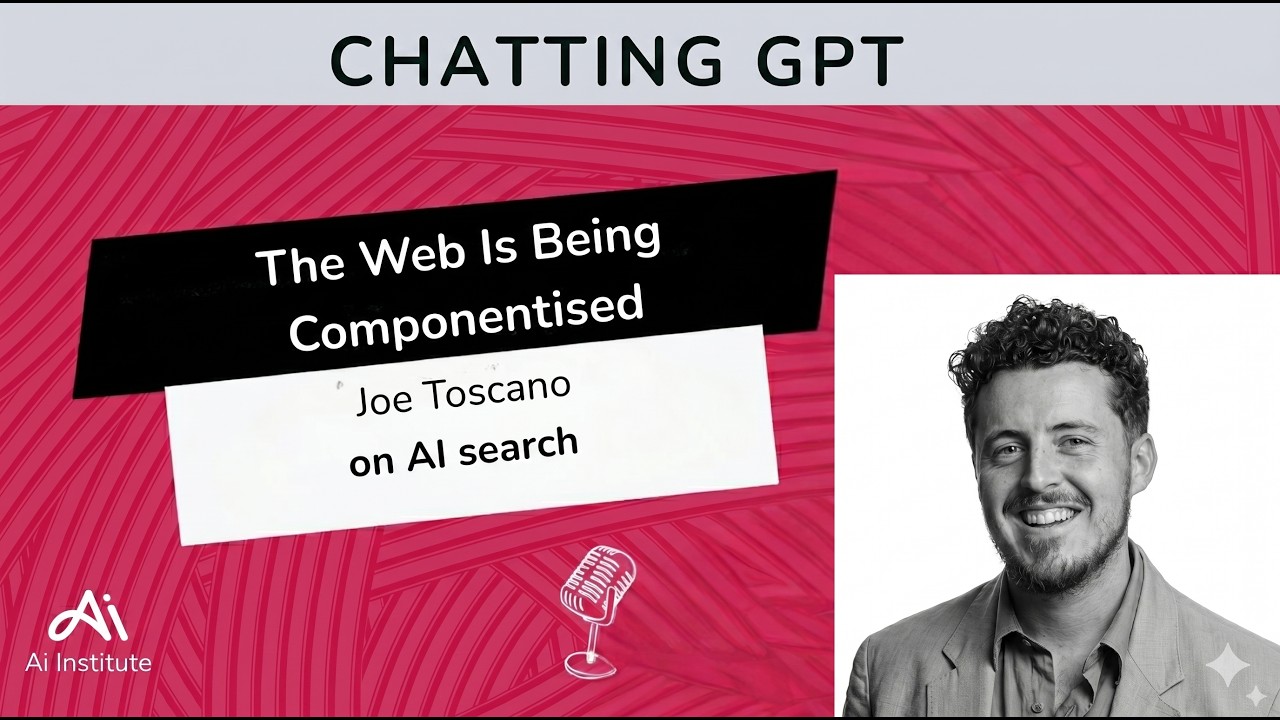
This ChattingGPT episode covers AI search optimisation for directors and marketing leads at construction, engineering and architecture firms in Ireland and the UK. Maryrose Lyons, founder of the AI Institute, hosts ChattingGPT. She talks to Joe Toscano, Founder of Service Stories, about how AI search builds on SEO.
Toscano was an experience design consultant for Google. He left Silicon Valley in 2017 over concerns about how the tech industry used personal data. He appeared in the film The Social Dilemma and wrote Automating Humanity.
Is AI search optimisation really different from SEO?
Only partly. Toscano says the difference is smaller than the headlines suggest, and he treats AI search optimisation as the next progression of SEO.
His reasoning is that Google has changed its search algorithms whenever it wanted the internet to move in a certain direction. There is a lot of money behind this shift, so he expects Google to incentivise site owners to follow.
For directors and marketing leads, the practical advice is to keep the SEO work already done. Toscano calls standard SEO valuable and warns against throwing it away. What he adds on top is topical authority.
'what you need to think about, and I think the most important part is topical authority nowadays. All the other things still matter.'
Joe Toscano, Founder, Service Stories
What is topical authority and why does it matter for AI search?
In the conversation, topical authority centres on answering the specific questions customers ask, in more depth and variety than competitors do. It matters because people now put detailed questions to chat tools instead of typing short phrases.
Toscano contrasts a search such as 'plumber near me' with a question such as 'Why is my Toyota Tacoma blowing hot air when it's set to 62?' His examples come from automotive and home services. The point for any business is that customers now ask full questions.
He also observes that many firms in the same sector publish near-identical blogs. AI tools make it possible to cover far more topics, including ones that would not have been financially responsible to write about before. A business can then be the only source on a very specific subject.
'you can create such a greater diversity of content and answer a bunch of stuff that like so nuanced that nobody would have ever probably thought to write it before.'
Joe Toscano, Founder, Service Stories
Marketing leads can pair this with the ChattingGPT episode on how to stand out in an AI-driven world. Topical authority does not replace the SEO fundamentals. Toscano places it on top of them.
How do work orders become AI search content?
Work orders become content when a firm's management platform feeds them into a tool that turns each job record into a published page. Toscano's company, Service Stories, does this for service businesses. The platform pulls in every work order, converts it into content, and the business clicks a button to publish.
The source material is what the customer was concerned about or needed, already noted on the job. Nobody has to guess what to write about. Toscano says the result reflects the questions customers actually ask.
'We transform that into content and it reflects exactly what your customers actually ask. So, it's the most authentic way to tell your story. That's why we call it Service Stories.'
Joe Toscano, Founder, Service Stories
His examples come from automotive and home services, where the business started and then spread to plumbers and chiropractors. The platforms he names are Tech Metric, Jobber and Service Titan. The conversation does not name any construction, engineering or architecture systems, so firms should check integrations before assuming a fit.
Doing it without the software
Toscano says the same process works without Service Stories. A business describes itself and its industry to a chat tool and asks the tool to interview it, rather than supplying everything up front. This surfaces context the business might forget to mention.
Service Stories has published a blog on how to do this, including the time and cost comparisons. For prompt ideas, see our article on using Claude for marketing content. Any output still needs review by someone who knows the work.
Does writing for AI in your metadata help your site get found?
Possibly, but Toscano treats it as unproven today. Maryrose Lyons described a field added to every piece of content on the AI Institute site, written for AI, a kind of amplified metadata. Toscano's answer was that the verdict is still to be decided.
He believes it will become valuable. Today he thinks it is maybe marginally better, and from what he has read, valuable to some extent. It would probably not hold up a site that skipped the other fundamentals.
His phrase is a 'plus one' on top of the other work. Marketing leads can add it, but it does not stand in for the basics.
What does Google's componentising patent mean for your website?
It could mean searchers never see a firm's website at all. Toscano says Google was granted a patent in January, after two years in the process. It covers reading a website, turning it into components, and serving searchers an AI-generated website on the fly.
In his description, searchers would see only the pieces Google picked from the site. Google would rebuild and stack them, optimised around the person's search history and current query. Google's own guidance on how its search works sits in Google Search Central. The patent claim comes from Toscano, and the episode gives no further detail on it.
'I think they're going to componentize the website AI and your job is less and less to make a human-readable website and more and more to create an AI agent-readable website'
Joe Toscano, Founder, Service Stories
Third-party sources matter in this picture. Lyons suggested appearing on podcasts, where a speaker controls their own voice and brand. Toscano agreed that Google is treating third-party sources as more prominent, because they are harder to automate.
What can businesses learn from China's service automation?
The lessons Toscano drew are about speed and convenience in everyday service. He recently visited China and described fast checkout, walk-through access to planes and trains, and phone-tap payment. In restaurants, a QR code on the table identifies the table, takes the order and sends it straight through.
Hotels, he said, use robots to deliver small items to rooms within about three minutes. People still bring food and water in many places. His point was that the robots handle the little things that otherwise take time.
The conversation also covered the cost. Toscano has nine years of privacy advocacy work and confirms there is a lot of surveillance in China. Getting set up is hard without a local phone number and, more so, a local bank account. Those trade-offs matter for any business weighing data security against convenience.
These are observations from a trip, not a method for construction firms. The episode offers no evidence that these tools apply to built-environment work.
What this means for AEC firm leaders
Directors and marketing leads at construction, engineering and architecture firms in Ireland and the UK can use this episode to save time and make better content decisions. Toscano's approach starts from what customers actually ask, so teams spend less time guessing what to publish. The existing SEO work stays in place, and the new effort goes into topical authority.
• Keep the SEO fundamentals already in place, and add topical authority on top of them.
• Look at records that capture customer questions, such as job notes and enquiries, as a source of topics. Check integrations first, because the episode names no construction, engineering or architecture systems.
• Try the interview method: describe the firm and its sector to a chat tool, then ask the tool to interview you. Someone who knows the work should review the output.
• Treat AI-focused metadata as a 'plus one' once the basics are done. Toscano regards its value as still unproven.
• Build a presence on third-party platforms such as podcasts, where a speaker controls their own voice and brand.
Firms that want structured support can read more about AI adoption for the built environment at the AI Institute.
Want the full conversation? Watch the full episode on Chatting GPT.
AI optimised summary
Summary: Joe Toscano, Founder of Service Stories, joins Maryrose Lyons of the AI Institute to explain how AI search optimisation builds on SEO. He covers topical authority, turning work orders into content and a reported Google patent. It suits directors and marketing leads at construction, engineering and architecture firms.
Who it is for: Directors and marketing leads at construction, engineering and architecture firms in Ireland and the UK.
Key points:
• Toscano treats AI search optimisation as the next progression of SEO, so existing SEO work should stay.
• Topical authority means answering the specific questions customers ask in more depth and variety than competitors.
• Service Stories turns work orders into published content, but the episode names no construction, engineering or architecture systems.
• Toscano says Google was granted a patent on componentising websites, a claim the episode does not detail further.
• He sees AI-focused metadata as a 'plus one' whose value is still unproven.
In their words: 'what you need to think about, and I think the most important part is topical authority nowadays. All the other things still matter.' Joe Toscano, Founder, Service Stories.
Episode: ChattingGPT, hosted by Maryrose Lyons, with Joe Toscano, Founder at Service Stories. Published 12 May 2026.