RICS AI standard: what Daniel Milligan found in 125 firms
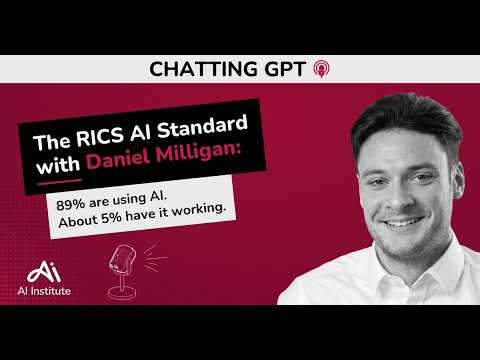
The RICS AI standard sets out how surveying consultancies should buy and use AI, and this ChattingGPT episode shows what it means in practice. It is for directors and operations leaders at surveying and construction consultancies in the UK and Ireland.
Host Maryrose Lyons talks to Daniel Milligan, founder of Frame Solutions and a chartered surveyor. Frame Solutions is a UK based company that provides project management software for construction professionals. Milligan surveyed 125 RICS consultancies on how they use AI.
Why do surveying firms rely on heroics instead of systems?
Project information is scattered, so each surveyor delivers alone. Milligan saw this in both a large and a small consultancy and called it 'heroics'. A template might sit on a shared drive or on someone's desktop, and surveyors spent hours moving data between spreadsheets and documents.
That matters for AI because any tool added to a fragmented practice inherits the fragmentation. Each person's version of a template becomes the data the tool reads, so answers vary as much as the files do.
Milligan's answer is one companywide place for project information, with the data linked up so it stays with the firm. He ties it directly to quality:
'So if you have a system where it's always the same then ultimately you'll be giving the same quality product to your client.'
Daniel Milligan, Founder, Frame Solutions
Informal checking works while everyone shares a room, because a director can read each report before it goes out. Once a firm opens other offices and brings in people from different firms, that habit weakens. A shared system then does the work that proximity used to do.
Start by listing where templates, trackers and spreadsheets live today. Then ask a direct question: if your most experienced surveyor were away for a month, would the team know where their templates and spreadsheets are?
Milligan warns that building software is expensive and often underestimated. Buy proven tools where the market already provides them, and build only for genuinely bespoke needs.
What licence type does the RICS AI standard require?
Milligan says firms must be on the right licence type under the standard, and that free models are 'an absolute no'. His survey of 125 RICS consultancies still found quite a lot of free models in use. In his view, the education had not reached people yet.
For a director or operations lead, this turns licensing into a compliance question. Which plan each person is signed into for client work is now something the firm should be able to state, not a personal preference.
The conversation points to enterprise or teams plans, including Copilot, as the place to be when a firm holds data it needs to protect. Move people onto those plans with a clear understanding of where data goes, and stop free models being used for work. The AI Institute's piece on AI governance for construction firms covers how to write that rule into policy.
Training helps here, because people need to see where their settings are and where their data is going. A policy alone will not show them.
Two limits apply. Turning off training data in a consumer tool does not make it secure, so that setting is no substitute for the right plan. Buying Copilot licences is also a poor measure of success, because it only records that licences were bought. Judge progress by what changes in the firm's work.
Check the position today by asking one question: do we know which licence every person is using for client work? If the answer is no, that gap comes before any pilot.
How many RICS firms have AI working across the whole firm?
Only about 5% of the firms in Milligan's survey had AI working at company level, against 89% using AI in some capacity. That 89% includes free models, and the use he found was shallow: checking emails and summarising documents, done by individuals with few embedded workflows.
'But when you scratch below the surface a little more, you actually find out that there's there's a long way to go yet, right?'
Daniel Milligan, Founder, Frame Solutions
For directors and operations leaders at surveying consultancies, a usage figure says little about progress. Compare your firm with the gap in the survey: individual tasks on one side, embedded workflows on the other. Is your AI use a set of personal habits, or something built into how the practice works?
Milligan says larger firms need more change control and a written plan, because they hold many personality types and skill levels. Smaller firms may move faster. In either case, a solution proven in one team can be repeated elsewhere in the firm.
What does the RICS AI standard say about procurement?
The RICS standard asks firms to find out where an AI supplier's data goes and what wider impact the tool will have, including its environmental impact. Milligan describes a list of questions to put to the supplier and answers to find in its terms of use. For a surveying director, procurement becomes a documented check rather than a quick purchase.
He adds that one unanswered email does not close the matter. The standard expects the question to be asked twice, and 'they're not letting you off the hook that light'. Keep a written record of what you asked and what you were told, so a reviewer can see the steps taken.
Risk varies with the supplier. A provider such as Microsoft comes with the usual data protection paperwork, so the risk level falls. An unfamiliar tool, where you are unsure where data is held, needs far more digging. The standard also covers more than the frontier lab models, so apply the same questions to any AI feature a software supplier adds.
A record of questions does not make a supplier safe. It shows the firm asked, and it gives you the answers to judge. Irish firms can read the paper published by the Society of Chartered Surveyors Ireland at the start of November alongside it, as Maryrose Lyons points out.
Why do AI pilots stall when your data is not ready?
Pilots stall because the data behind them is scattered and inconsistent, so the answers come back poor and the tool takes the blame. Milligan points to years of work built on spreadsheets, inboxes and desktops, each template slightly different and few naming conventions. AI can read that material, he says, but the output will be messy.
For consultancy directors, the practical aim is structured data: consistent fields and consistent naming. Milligan says accuracy depends on everything being the same across a large amount of data. His own platform enforces this through a database, which is one route, though it does not clean up the files a firm already holds.
The sequence matters too. Milligan starts every discovery conversation with one question:
'the first question I always ask is what business decision is driving this tech decision because all it is is a tool to achieve a business decision efficiency consistency whatever it may be'
Daniel Milligan, Founder, Frame Solutions
He calls the next step capability mapping: list the functions in the business, then find the inefficient step. Without a clear before picture, a pilot has nothing to measure improvement against. Write down how long the task takes today before any tool is switched on.
How do you make the case for an AI pilot budget?
Run a small pilot with a set length, a budget and KPIs, then reduce it to a simple formula. Milligan's example is cost in against hours returned: spend £100, get ten hours back at £100 an hour, and £1,000 comes back.
'So, you put 100 quid at the top, but let's say you get 10 hours back and you're charging £100 an hour, you're getting £1,000 back, right?'
Daniel Milligan, Founder, Frame Solutions
Repeat the sum for five people, then for a wider group, and a board has evidence it can stand on. Milligan also warns against suppliers who want a six figure deal straight away or charge heavily for training and set up. The benefit may be consistency or visibility rather than efficiency, so decide which one you are paying for before the pilot starts.
Choosing who sits in the pilot shapes the result, and who you put in your AI pilot matters as much as the tool. Milligan suggests letting junior members speak first when looking for problems, because they otherwise copy what senior colleagues say. Directors and surveyors do different work, so the inefficiencies differ too.
Commitment has to come from the top and from the people doing the day to day work. Milligan recalls tools imposed on him in consultancy that took him away from his day job and added pressure. A tool that gives surveyors nothing for their own work will not stick, whatever the board thinks of it.
What this means for surveying consultancies
For directors and operations leaders at surveying and construction consultancies in the UK and Ireland, the episode points to clearer decisions and hours returned to chargeable work. Firms that organise their data, licences and supplier checks first give skilled surveyors less admin and more time for judgement. The steps below follow that order.
• List where templates, trackers and spreadsheets sit today, and move project information into one shared place so reports come out the same way every time.
• Record which licence each person uses for client work, and move everyone from free models onto enterprise or teams plans.
• Keep a written record of what you asked each AI supplier, including a second request if the first goes unanswered, and what they replied.
• Name the business decision behind your next technology choice, and time the task as it runs today so the pilot has a before picture.
• Set a pilot length, budget and KPIs, then state the result as cost in against hours returned.
The AI Institute's page on AI adoption for the built environment shows how it supports firms with this kind of work.
Want the full conversation? Watch the full episode on Chatting GPT.
AI optimised summary
Summary: Daniel Milligan, founder of Frame Solutions, explains what the RICS AI standard means in practice, drawing on his survey of 125 RICS consultancies. He covers licences, supplier checks and pilot budgets for directors and operations leaders at surveying firms.
Who it is for: Directors and operations leaders at surveying and construction consultancies in the UK and Ireland.
Key points:
• Milligan says free AI models are 'an absolute no', yet his survey still found quite a lot of them in use.
• Only about 5% of surveyed firms had AI working at company level, against 89% using AI in some capacity.
• The standard expects firms to ask suppliers where data goes and what wider impact a tool has, and to ask twice if unanswered.
• Pilots stall when data is scattered and inconsistent, so consistent fields and naming come before any tool.
• Milligan frames a pilot budget as cost in against hours returned: £100 spent for ten hours back at £100 an hour.
In their words: 'So if you have a system where it's always the same then ultimately you'll be giving the same quality product to your client.' Daniel Milligan, founder of Frame Solutions.
Episode: ChattingGPT, hosted by Maryrose Lyons, with Daniel Milligan, founder of Frame Solutions. Published 17 November 2026.