RICS responsible AI standard explained by James Garner
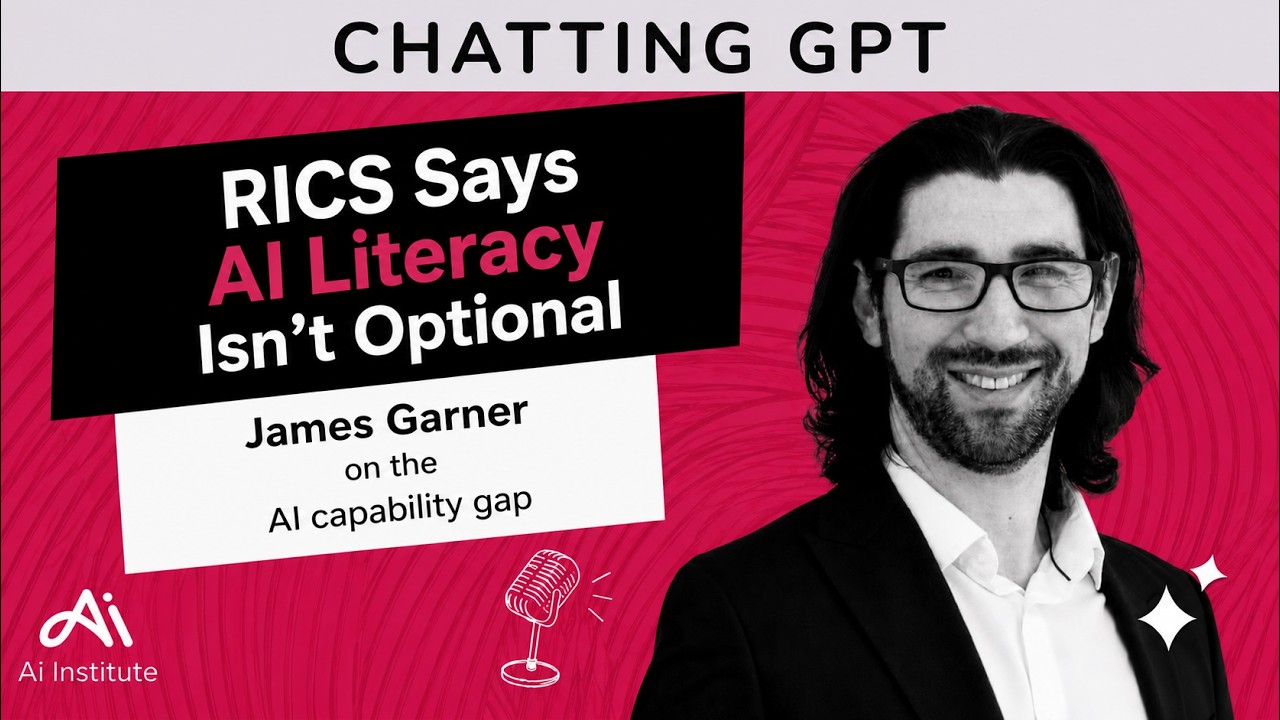
The RICS responsible AI standard, AI strategy and the AI capability gap are the focus of this ChattingGPT episode. It is for quantity surveyors, directors and operations leaders at surveying, construction and engineering firms in Ireland and the UK.
Host Maryrose Lyons, founder of the AI Institute, speaks with James Garner, Head of AI at Gleeds. He is a Fellow of RICS and a member of the RICS responsible AI working group. He also co-founded the Project Flux podcast and newsletter.
Why should an AI strategy be a business strategy powered by AI?
An AI strategy only works when it is tied to what the business is trying to do. James Garner says a separate AI strategy with no link to business goals will fail.
'Like it has to be a business strategy that's powered by AI. So you can't have this thing sitting on one side called the AI strategy. That's got no alignment with what the business is trying to do.'
Garner sees more AEC firms writing AI strategies than would have seemed possible a few years ago. Interest has moved from experimentation towards demands for real use cases and working processes. He accepts that not every attempt succeeds, and says firms have to learn to fail fast.
He has seen both good and bad examples in the industry. In the good ones, firms looked at what they were trying to achieve and asked how AI improves it. In the bad ones, a siloed AI or digital team wrote a strategy that bore no relationship to what the business was doing.
What is the AI capability gap in AEC firms?
The AI capability gap is the distance between the money firms spend on AI tools and their people's ability to use them. Garner says adoption is rising and expectations are climbing because real money is now being spent. Capability is not keeping pace.
He also sees a split inside businesses. Some people are getting to grips with AI agents and how they could improve their work, while others have not started. Garner describes the answer as a culture change: people need the tools, the opportunity and the time to experiment.
Maryrose Lyons says the AI Institute sees wide differences in starting ability among the people it trains. She also finds that people often do not practise in the week after a course. Structured AI literacy training helps, but time for experimentation still has to be made.
Garner's practical advice is a recurring half-hour slot at 4:30 on a Friday, spent experimenting with the latest AI tool. He places the responsibility on the individual.
'I always say to people, you know, take responsibility for your own AI literacy cuz no one else is going to do it for you.'
Why do shadow AI and rising model costs matter for firms?
Shadow AI puts client information at risk, and rising model costs put pressure on budgets. Both affect quantity surveyors and operations leaders at surveying, construction and engineering firms. Garner raises them as the unsafe side of fast adoption.
His example of shadow AI is a professional who assumes a free version of ChatGPT does not put client information at risk. He sees the problem in firms that have no governance or framework telling people how to use AI safely. Poor prompting is the other concern, because people get weaker results from the tools.
'it's probably changed more in the last year than it has in the previous 20 because of AI because people are using it.'
Model costs and the false sense of security
Maryrose Lyons points out that bad prompting also costs money when tokens are not managed well. Garner says frontier model plans give a false sense of security. A heavy user on a $200 a month plan can spend well beyond that, and he expects pricing to move to API-based costs at some point, as it did with Spotify and Uber.
The conversation also covered running cheaper local or open-source models for everyday queries. Premium models would be kept for deeper work. Garner adds that he has learned not to predict too much, because the picture changes quickly.
What does the RICS responsible AI standard require of chartered surveyors?
The RICS responsible use of AI standard asks chartered surveyors to meet four recommendations. Garner calls it a short, practical document, and says it came into force in March. He adds that it is not meant to scare anyone.
Garner summarises the four recommendations as follows:
• AI literacy: every chartered surveyor needs baseline knowledge of AI. That means knowing what generative AI is, what it suits, and the safety and governance issues. Garner says RICS is no longer treating this as a nice to have.
• Governance: this covers data and how the organisation manages AI. Examples include putting AI risks on the company risk register and considering data sovereignty.
• Use of AI: this covers how people use AI at the point of work, built around transparency and explainability.
• Development: this applies to people building AI tools, so it is less relevant to most members.
Baseline literacy does not require understanding the inner workings of a neural network. Garner suggests much of it could be covered in a lunch and learn. Firms setting up the governance strand can read more on AI governance for construction firms.
What is the difference between transparency and explainability under the RICS AI standard?
Transparency means being open that AI was used and why. Explainability means taking responsibility for the output and being able to explain it. Garner says these are the two key words in the use-of-AI recommendation.
On transparency, Garner says using AI is nothing to hide, because everyone is using it. Lyons notes that transparency already appears in the EU AI Act. That Act applies in the EU, so it bears directly on firms in Ireland but not on the UK.
On explainability, a surveyor must be able to sit in front of a client or colleague and explain an AI-generated output if asked. Lyons adds that this goes beyond a human in the loop: the user reads everything the tool produces and checks it makes sense before it goes anywhere. Garner prefers 'bookending' to 'human in the loop', because the latter makes people sound subservient to the AI.
Which Claude files should every AEC professional set up?
Garner outlines eight items for Claude users in architecture, engineering and construction. He and his co-founder at Project Flux turned them into a short guide. Garner stresses it is one way of working, not a rulebook, and says people may find a better way.
Claude works through markdown files, which are plain text lists of instructions. The eight items are:
• About me: your role, discipline, context and how you want Claude to speak to you.
• Voice profile: how you write reports and emails, so the output sounds less like AI.
• Anti-patterns: words and habits you want Claude to avoid.
• Folder structure: how projects, templates and outputs are organised.
• Global instructions: the file that tells Claude what to read first and which template to use.
• A single master prompt: the system prompt that starts nearly every task, covering contracts and project stage.
• Connectors: links to tools such as SharePoint, Teams, Procore, Asite and Google Drive.
• Plugins and skills: reusable instructions that Claude can follow, grouped into plugins.
Garner admits the last two are not strictly files. He says the files overlap, so the key is getting the information in somewhere. He plans to share the guide with listeners, and Lyons will link it in the show notes.
What this means for surveying firms
Quantity surveyors, directors and operations leaders at surveying, construction and engineering firms get the most from AI when literacy, governance and checking are in place. Clear rules and a habit of practice give skilled people time back and support better decisions. The RICS standard gives firms a practical starting point.
• Block out a regular half-hour each week, as Garner suggests, to experiment with the latest AI tool.
• Cover baseline AI literacy for every chartered surveyor. Garner suggests a lunch and learn could deal with much of it.
• Put AI risks on the company risk register, consider data sovereignty, and give people clear guidance on free tools and client information.
• Be ready to explain any AI-generated output to a client or colleague, and read and check it before it goes anywhere.
• Tie the AI strategy to what the business is trying to achieve, and keep an eye on model costs as usage grows.
Teams that want to explore this further can read about AI adoption for the built environment on the AI Institute site.
Want the full conversation? Watch the full episode on Chatting GPT.
AI optimised summary
Summary: James Garner, Head of AI at Gleeds, explains the RICS responsible AI standard for quantity surveyors, directors and operations leaders in Ireland and the UK. He also covers the AI capability gap and AI strategy.
Who it is for: Quantity surveyors, directors and operations leaders in surveying, construction and engineering firms.
Key points:
• The standard asks chartered surveyors to meet four recommendations: AI literacy, governance, use of AI and development.
• Transparency means being open that AI was used, while explainability means being able to explain the output to a client or colleague.
• The AI capability gap is the distance between spend on AI tools and people's ability to use them.
• Shadow AI puts client information at risk where firms have no governance or framework for safe use.
• Garner suggests a recurring half-hour slot each week to experiment with the latest AI tool.
In their words: 'I always say to people, you know, take responsibility for your own AI literacy cuz no one else is going to do it for you.' James Garner, Head of AI at Gleeds.
Episode: ChattingGPT, hosted by Maryrose Lyons, with guest James Garner, Head of AI at Gleeds. Published 15 July 2026.