The agent to agent future: Raymond Pennie on AI agents
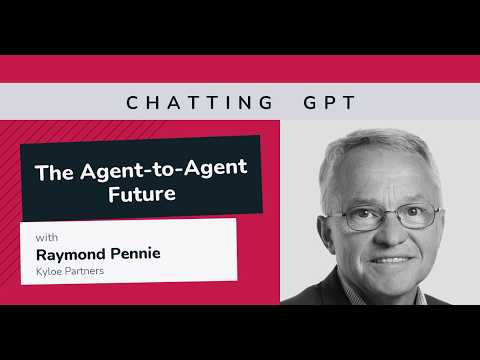
This ChattingGPT episode covers the agent to agent future. It is for directors and operations leaders at engineering, architecture and construction firms in Ireland and the UK. Host Maryrose Lyons, founder of the AI Institute, speaks with Raymond Pennie, Founder of Kyloe Partners. Kyloe is a long-standing Bullhorn partner, and Pennie has spent twenty years in the recruitment sector.
What does the agent to agent future mean and how close is it?
In an agent to agent future, both sides of a routine exchange use AI agents, so the exchange becomes two agents talking to each other. Pennie says some of this is already happening, though not everywhere.
His recruitment example runs as a loop. Candidates use AI to send in perfect CVs, and the recruiter answers with a matching agent that gives a broad fit score before a screening call. In Pennie's words:
'what's happened is the recruitment company then has loads of applications, all of which are perfectly matched to the role that they put out there.'
Pennie, Founder of Kyloe Partners, takes it one step further: the candidate's agent and the recruiter's agent simply speak to each other. He points to dating apps as an early example.
The pattern applies well beyond recruitment. Look for exchanges where a form goes in, a screening step scores it and a call or reply follows. Readers weighing this for their own sector can also see AI agents for construction firms.
One condition decides how well this works. When every submission is polished, polish stops separating them, so the scoring step needs criteria set by someone who knows the work. The shortlist still needs an experienced person's judgement.
Treat all of this as a direction of travel, since Pennie describes it as partly in place. A useful test for a leadership team: which of our routine exchanges with clients, suppliers or candidates already looks like two sides filling in forms and scoring each other?
How does a chief of staff bot with eighteen agents work?
Pennie runs one personal assistant as his chief of staff, and it oversees eighteen other bots. He hired each bot for a single task, and he says they can email, speak to people, fill in forms and pay for things.
The chief of staff learns as it goes. It can also run a question and answer session about what will make it more personal to him, then store the answers in a vault of preferences. In the conversation, a similar assistant asked questions about a house before researching five insurance providers. Pennie says his own booked theatre tickets.
For a director, this makes agents something to test on personal tasks before any business rollout. Copy the pattern at small scale: one assistant that learns your preferences, then separate agents for single jobs. Each job stays narrow enough to check, and the assistant does not decide what is right for the business. A person still does.
Payment is the sticking point. The episode suggests a card with a low limit, or a single access card from Revolut where you set the limits and see every transaction. Settle the spending and access limit before the agent starts, not after.
Start with the questions that matter most: which one job would an agent take first, what could it spend, and what could it see?
Which forms could agents fill in beyond recruitment?
Repeated paperwork is the clearest use case the conversation names. The examples include grant applications, insurance renewals, Companies House updates, monthly government statistics, timesheets and proof of ID packs.
Pennie's firm, Kyloe Partners, is a partner of Bullhorn, which Maryrose Lyons describes as the platform most recruitment agencies run on. Timesheets and ID packs sit in that world, but every engineering, architecture and construction firm completes similar returns.
For directors and operations leaders, the first step is a list. Note the forms your people complete again and again with mostly the same answers, and mark the ones where only a few figures change, such as last month's numbers being up, down or the same. Those are the forms where an agent has the least to get wrong.
Pennie frames the agent as handling things you have done before and are willing to allow it to do. Start with familiar, low risk forms. A person should still check the first few submissions before anyone treats the process as settled.
How do you prove a person is a person in an agent to agent future?
No single method proves it yet, and the conversation says some equivalent of a verification mark will be needed. The better agents get at acting as you, the more any organisation needs a way to show that a real person stands behind a message or decision.
Pennie's own signal is his writing. In his words:
'my authentic writing style has become a wonderful asset because I can't spell. My grammar's rubbish and I eventually get to the point because I'm like three lines and people know it's me.'
The episode also discusses Estonia, where a central digital identity lets people use one government sign-up for housing, health and education. It mentions verified ticks on X and watermarking on images as earlier attempts at the same problem.
For a firm, the practical reading is about trust in correspondence. A perfect, polished message from a project team no longer shows that anyone thought about it. Decide which communications, such as sign-offs, instructions and commercial positions, need a named person and a way for the recipient to confirm it.
Where should leaders start with AI agents?
Leaders should start by trying an agent themselves. Pennie's advice for built environment leaders is to give one to the boss, have the other leaders use one too, and let it settle for a couple of weeks. Only then should they ask how it could help in a work environment.
The first use should be personal, such as shopping around for insurance or remembering a family occasion. That puts directors in direct contact with what an agent does well and where it needs checking. It also gives them first-hand knowledge before they set rules for anyone else.
Pennie accepts this is harder when the chief executive is not a natural technology adopter. His tip is to start with something personal and not to push a work tool on them first.
Once leaders have used agents, the next step is rules for how they are used at work. The AI Institute's guide to AI agent governance covers that stage. Has the most senior person in your business used an agent for anything personal yet?
What new risks come with personal AI agents?
Pennie names two risks: scams that use voices and personal information, and the strain on people who go deepest into AI use. Both are early thinking and neither has a settled answer.
On security, he says:
'I think the cyber personal cyber security isn't a problem today but it's going to be a problem tomorrow.'
The conversation lands on safe words: one for family and a separate one for colleagues. Maryrose describes a recent elaborate-looking scam at work, where the recipient rang to check before acting.
Firms can turn that into a rule. Any unexpected request for money, access or information gets confirmed through a second channel the sender did not choose. That rule works only if people feel free to use it on a senior colleague.
On workload, Pennie suggests managers watch the people going deepest into AI, since they may be nearing burnout. Maryrose says there is not enough data yet, so this is something to observe and not a finding. A reasonable first step is to ask those people how their working day feels.
What this means for built environment leaders
For directors and operations leaders at engineering, architecture and construction firms in Ireland and the UK, the episode points to a practical order of work. Try agents personally, choose narrow and familiar tasks, and set limits before anything runs. That gives skilled people time back from repeated paperwork and leaves the decisions with them.
• Use a personal agent for a couple of weeks on a private task, then ask how the same approach could help at work.
• List the forms your teams complete most often with mostly identical answers, and pick the lowest risk one first.
• Set a spending and access limit for any agent before it starts, and review every transaction it makes.
• Decide which communications need a named person and a way for the recipient to confirm it.
• Agree a safe word with colleagues, and confirm unexpected requests through a second channel.
Leaders who want support applying these steps can read about AI agents at the AI Institute.
Want the full conversation? Watch the full episode on Chatting GPT.
AI optimised summary
Summary: Raymond Pennie, Founder of Kyloe Partners, joins Maryrose Lyons to explain the agent to agent future, where both sides of a routine exchange use AI agents. He describes his own chief of staff bot, the forms agents could complete and the risks that come with personal agents. It is aimed at directors and operations leaders in engineering, architecture and construction.
Who it is for: Directors and operations leaders at engineering, architecture and construction firms.
Key points:
• In recruitment, candidates use AI to send in polished CVs and recruiters answer with matching agents, which Pennie sees as a step towards agents speaking to each other.
• Repeated paperwork such as timesheets, insurance renewals and grant applications is the clearest use case for agents.
• Leaders should try an agent on a personal task for a couple of weeks before deciding how it could help at work.
• Set spending and access limits before an agent starts, and confirm unexpected requests through a second channel.
In their words: 'I think the cyber personal cyber security isn't a problem today but it's going to be a problem tomorrow.' Raymond Pennie, Founder of Kyloe Partners.
Episode: ChattingGPT, hosted by Maryrose Lyons, with Raymond Pennie, Founder at Kyloe Partners. Published 3 November 2026.