AI in MEP engineering with Niklas Lindgren
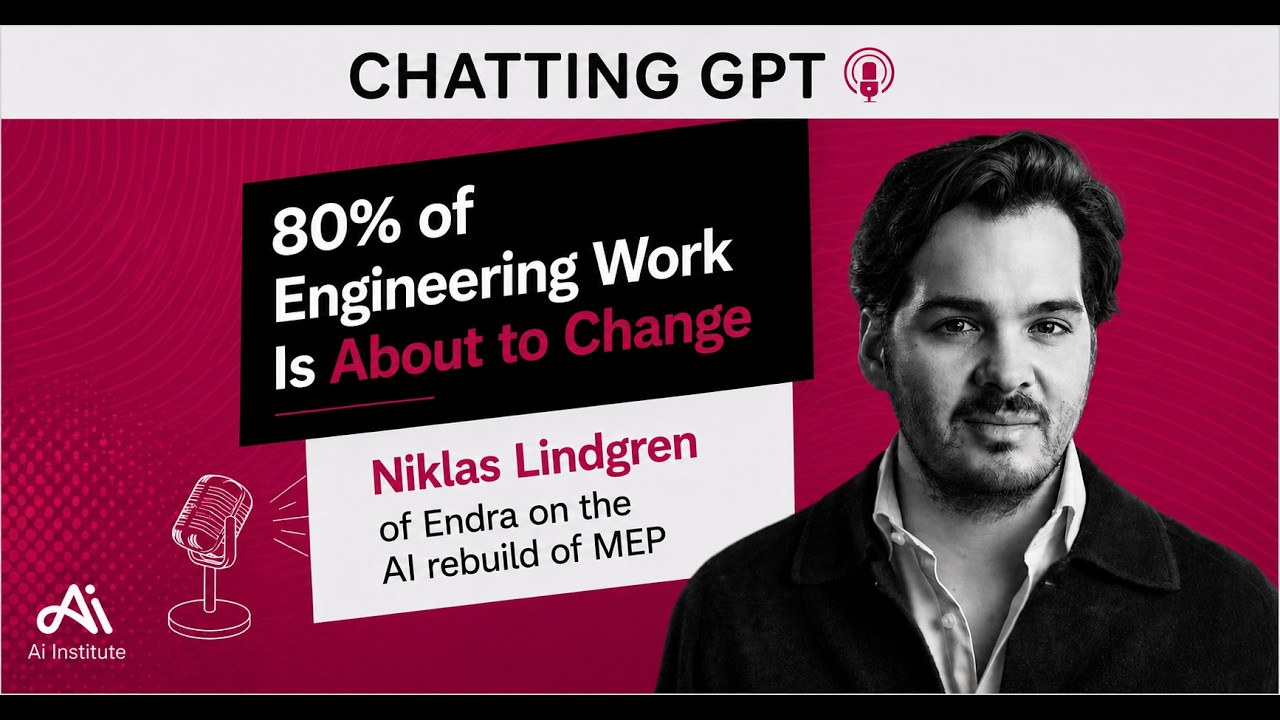
This episode of ChattingGPT explores AI in MEP engineering and why the sector has been slow to adopt it. It is for directors and operations leaders at MEP engineering consultancies in Ireland and the UK.
Maryrose Lyons, founder of the AI Institute, hosts ChattingGPT and speaks to Niklas Lindgren, founder and CEO of Endra. Endra is a Stockholm-based AI platform for mechanical, electrical and plumbing engineers. It raised a $50m Series A led by Andreessen Horowitz and counts Buro Happold among its users.
Why has MEP engineering been so slow to adopt AI?
MEP engineering has been slow to adopt AI because the work is complex, spread across separate workflows and hard to build software for. For MEP directors, that explains why the sector has changed little in a long time.
Niklas Lindgren describes three layers of complexity. The first is drafting, mainly in Revit, with some AutoCAD. The second is the engineering or calculation layer, where the engineering work gets done. The third is coordination, in tools such as Navisworks, where the model is checked and coordinated.
Each layer sits in a different workflow, which compounds the difficulty. Leaders who want to understand the first layer in detail can read about why Revit workflows are so time-consuming.
The technical challenge is also considerable. Lindgren says Endra is trying to apply academic research in areas such as spatial AI and simulation to this type of system. In his view, a firm cannot build that internally, because it is too expensive. It takes scale and investors who believe in the mission.
Large language models play a specific and limited role. Endra uses them to structure unstructured BIM data into a data model that works with its own platform. Lindgren says they are really bad at tasks such as routing a conduit or a duct inside a building, so Endra does not use them for that.
He is clear about the stakes for firms that ignore the shift:
'it will meaningfully change how like 70 to 80% of the actual hours being spent on a project being done.'
Why is Autodesk a partner and not a competitor for Endra?
Autodesk is a partner for Endra because the platform integrates natively with the Autodesk suite that its customers already use. Lindgren says Endra does not see Autodesk as a competitor at all.
Maryrose Lyons asked why an incumbent had not moved faster. Lindgren says Autodesk has historically acquired its way to its market position rather than building new software. He adds that MEP has not been a huge focus area for the company.
He would expect Autodesk to buy a company if it wanted to pursue this area. That is his view of the company's pattern, not something he reports Autodesk has said.
For MEP engineers, the practical point is that Endra aims to be as native as possible alongside Autodesk tools. Lindgren says Endra is not building a new Revit. He expects users to spend more time in Endra than in Revit over time, while still keeping Revit.
He also says the design of Endra keeps an engineer in control at all times. The platform supports the engineer's decisions and does not replace them.
How will AI in MEP engineering change 70 to 80% of project hours?
Niklas Lindgren expects AI to change how 70 to 80% of project hours are spent. For directors at MEP engineering consultancies, that makes understanding the shift a planning task for this year.
He says he is very sure of this, based on what he sees inside Endra and inside the engineering organisations using it. Firms that adopt it properly, he argues, will do much more, and he says history has shown this before.
Endra's design keeps an engineer in control at all times. The platform supports engineering decisions and leaves them with the engineer.
Lindgren says Endra works with some of the most sophisticated companies globally, and Buro Happold is one of them. He reports that engineers are interested and want to understand what is changing. About 90% of the user cohorts Endra works with show great engagement.
How can engineering firms build new services and pricing with AI?
Engineering firms can build new services by using the time AI gives back to offer owners and contractors options they could not price before. Lindgren sees this as the real opportunity for MEP consultancies.
'Firms that as I said will adopt this will start offering new products to their owners.'
He gives a worked example. A consultancy's fee might be $500,000 on systems worth $30 million, which is small next to the installed cost. If the firm can design five different systems, it can show a general contractor what each one would cost.
Endra has modelled this to a detailed level, so the difference between options is visible and works for both sides. Lindgren says firms can also charge for speed to market and build a stronger position with their customers.
Maryrose Lyons says this matches the AI Institute's view. The aim is to expand what skilled engineers do and to open up new service offerings that firms would not have considered before.
Why are outsourced engineering teams the most exposed?
Outsourced engineering teams in other regions are the most exposed because AI moves value towards the engineers who make the decisions. Lindgren says this has been his consistent view.
'I think the outsourced outsourced teams in in other regions will have a very hard time proving the value because we're basically moving the value they're getting to the engineers that that makes the decision.'
He expects the change to come fast, possibly within the next year or so. Firms would move from outsourced models to using technology for the same type of work.
Maryrose Lyons asked whether new tasks might be outsourced instead. Lindgren said maybe, but he thinks they would become more of a junior task inside the firm.
His reasoning is about compounding value. He would rather invest in junior talent who learn the firm's operation over several years than send work to an outsourcing agency in Bangalore. For UK and Irish MEP directors, that is a question worth putting to their own delivery model.
What should MEP engineering firms do about AI this week?
MEP engineering firms should start by deciding how they think about the technology shift and where they position themselves in it. Lindgren says every engineering organisation should understand that AI will meaningfully change how engineering gets done.
Maryrose Lyons puts it more bluntly: get an AI strategy or plan in place if you have not got one, and look to the larger firms already ahead. Lindgren notes that the largest players in the industry are leading the change.
He also stresses the timescale. Customers working with Endra are not running a small pilot. They are making a bet on transforming their business, and in some cases Endra teams sit in the customer's offices as part of the organisation.
Reaching full scale, in his view, takes a year or two. Maryrose Lyons adds that it is a people game as well as a technology one. It needs skilled people to drive the technology and manage the change, and AI project manager roles are appearing for this reason.
Directors who want a structured starting point can read a practical guide to AI implementation in construction and engineering.
What this means for MEP engineering leaders
Directors and operations leaders at MEP engineering consultancies in Ireland and the UK can use this episode to decide where AI gives skilled engineers time back. Lindgren argues that those hours can go into better decisions, new services and a stronger position with owners and contractors. The engineer stays in control throughout.
• Map where project hours go across the three layers Lindgren describes: drafting, engineering calculation and coordination.
• Test a multi-option service, as in his example of designing five systems so a general contractor can compare what each would cost.
• Ask how your delivery model would hold up if value moves to the engineers who make the decisions, and consider investing in junior talent inside the firm.
• Put an AI strategy or plan in place, and give skilled people the task of driving the technology and managing the change.
• Plan for a year or two to reach full scale, as Lindgren describes, rather than a small pilot.
Leaders who want structured support can explore AI adoption for the built environment at the AI Institute.
Want the full conversation? Watch the full episode on Chatting GPT.
AI optimised summary
Summary: Niklas Lindgren, founder and CEO of Endra, joins Maryrose Lyons to discuss AI in MEP engineering and why the sector has been slow to adopt it. He sets out three layers of complexity and how AI may change project hours. The episode is for directors and operations leaders at MEP engineering consultancies in Ireland and the UK.
Who it is for: Directors and operations leaders at MEP engineering consultancies in Ireland and the UK.
Key points:
• MEP has been slow to adopt AI because the work spans drafting, engineering calculation and coordination, each in a different workflow.
• Endra works natively alongside Autodesk tools, and its design keeps the engineer in control.
• Lindgren says firms can use the time gained to offer owners and contractors new options, such as pricing five different system designs.
• He expects full scale to take a year or two, and says customers are betting on transforming their business, not running a small pilot.
In their words: 'it will meaningfully change how like 70 to 80% of the actual hours being spent on a project being done.' Niklas Lindgren, founder and CEO of Endra.
Episode: ChattingGPT, hosted by Maryrose Lyons, with Niklas Lindgren, founder and CEO at Endra. Published 11 August 2026.