AI voice agent: how Matt Cortland and John Fleming built one
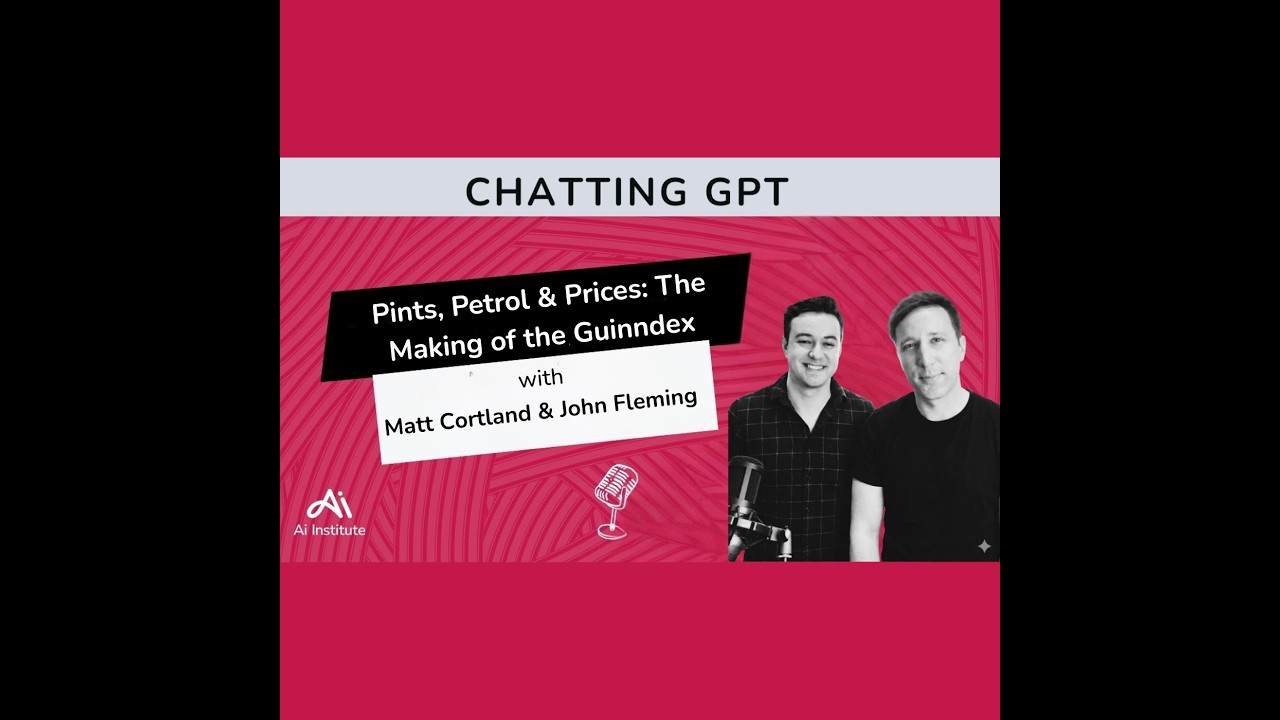
This ChattingGPT episode shows how to build an AI voice agent from off-the-shelf tools. It is for directors and operations leaders at engineering, architecture and construction firms in Ireland and the UK.
Host Maryrose Lyons, founder of the AI Institute, speaks with Matt Cortland and John Fleming, creators of the Guinndex and the Gas Index. They called over 700 pubs across Ireland and Northern Ireland for approximately €200, then applied the method to US petrol stations.
Why did the CSO stop tracking the price of a pint?
The Central Statistics Office tracked the price of a pint, including stout and lager, until 2011 and then stopped. The episode does not give a reason. That left a 14-year gap in the official record.
Matt Cortland noticed the gap after paying a high price for a pint on a visit to Ireland and finding it cheaper two streets away. He went to the CSO data to understand the difference. The data sets themselves impressed him.
'I mean, it's all about APIs. How an AI agent can interact with an API in a data set. And the Irish government has spectacular data sets.'
Matt Cortland, co-creator of the Guinndex and the Gas Index
Official data had stopped, and pub owners do not put pint prices on their websites. John Fleming's suggestion was to call every pub. That became the brief for the AI voice agent.
How do you build an AI voice agent from off-the-shelf tools?
An AI voice agent can be built by connecting a handful of existing tools, each with one job. Matt and John used four, and the conversation describes how they fit together.
• Google Maps listings supplied every pub in Ireland and Northern Ireland, with phone numbers.
• ElevenLabs supplied the voice and an API for the AI agent.
• Twilio made the phone calls, linked to ElevenLabs through a phone number.
• Claude Code orchestrated the other tools.
The voice came from a person in Northern Ireland who had cloned their own voice on ElevenLabs. That person is paid when the voice is used. The pair tested several options before settling on one.
Claude Code ran from the command line. It held the API keys, called ElevenLabs and Twilio, stored results in a database and analysed the call transcripts. Calls ran in small batches: ten calls, a review of what came back, an improvement, then ten more. Only when the results were right did they call 200 pubs at once.
This pattern matters for anyone exploring AI agents for construction firms. Each batch needed a person to judge the output before scaling. The tools collect and sort information, but they do not decide what a good call looks like.
What went wrong in the first test calls?
The first test calls did not go correctly, and the guests say so plainly. For directors and operations leaders testing an AI voice agent, those early faults were useful because they surfaced before the calls scaled.
The aim was short calls, because pub staff are busy. On average a call lasted 20 to 25 seconds: ask the price of a pint, take the answer, hang up. Four faults showed up in practice.
• Pub staff who offered some banter got a quick thanks and goodbye in return. The agent struggled with Irish banter.
• Conditional phrasing of speech confused the agent.
• A silence while someone went to check a price could make the agent think the call was over, so it said goodbye.
• The Irish goodbye, a string of 'bye' exchanges, kept the call going.
The last fault had a specific cause, which John Fleming explained.
'No, it's a great point you raised because we actually had it set up at the start that she couldn't hang up the phone.'
John Fleming, co-creator of the Guinndex and the Gas Index
The fix was iteration. One voice model worked well for Ireland and a different one worked better for the US, because speech patterns and response delays differed.
How much does an AI voice agent project cost?
The Guinndex cost about €200 in total, according to the guests, to call over 700 pubs across Ireland and Northern Ireland. The episode does not itemise that figure or put a value on the time the pair spent.
The cost covers a narrow task: one question, asked repeatedly, with the answer recorded. The stack was Google Maps listings, ElevenLabs, Twilio and Claude Code. The figure does not cover any judgement a person adds, such as reviewing each batch of ten calls.
This is a single research project, so it should not be read as a price for every voice agent. A task with seven or eight questions per call is a different build. The guests think it would work, but say the choice of voice model matters because response speed differs between models.
How did the same system become a US Gas Index?
The Guinndex infrastructure was reused for US petrol stations, with new voices and new data sources. Matt Cortland described the result in one sentence.
'So, we applied similar methodology and we've made a real-time gas index of prices by pump in the US with a feature to tell you if it's worth to drive.'
Matt Cortland, co-creator of the Guinndex and the Gas Index
Google Maps data covered about 50% of US gas stations, and that data can be up to a week old. The other 50% had no prices available. A family of agents called Hank, Bobby and Peggy, inspired by King of the Hill, phoned stations to fill the gaps.
The Gas Index also lets users photograph a pump while they are at the station. The system extracts the price, uses location data to suggest which station it is, and asks the user to confirm.
The team made one technical change between projects. After a call with an ElevenLabs engineer, they set the platform to capture chosen data points during each call. John Fleming said the aim was a more complete data set:
'Then that'll allow us to have a more complete data set and that's hopefully in real time as it goes.'
John Fleming, co-creator of the Guinndex and the Gas Index
How do people react when an AI voice agent says it is an AI?
Almost all of them carry on the conversation. For the US calls, the agent said in its first sentence that it was an AI. Only one in 700 people objected, and that person was in America.
On the Guinndex, the agent disclosed that it was an AI only if asked. The guests changed this because the point was never to fool or trick anyone. They also chose a southern accent for the US agents to sound friendly and non-threatening.
Some people paused when they heard 'AI', then carried on as if speaking to a person. Many were polite, and some Irish pubs invited the caller in. Decisions such as when an agent discloses itself belong in AI agent governance, which any firm should settle before calling real people.
What this means for AEC leaders
Directors and operations leaders at engineering, architecture and construction firms can take a practical pattern from this episode. A repeated, narrow task can be handed to an AI voice agent, which leaves skilled people to judge the results. The decisions about what to ask and what counts as a good call stay with them.
• Start with one narrow question asked many times, as the Guinndex did with the price of a pint.
• Test in small batches. Review ten calls, improve the agent, then repeat before scaling to 200 at once.
• Expect early faults such as silences, banter and endless goodbyes, and fix them before real volume.
• Decide in advance when the agent tells people it is an AI. The US agent said so in its first sentence.
• Treat €200 as the cost of one research project, not a quote for every voice agent build.
Leaders who want to explore this further can read about AI agents at the AI Institute.
Want the full conversation? Watch the full episode on Chatting GPT.
AI optimised summary
Summary: Matt Cortland and John Fleming, co-creators of the Guinndex and the Gas Index, explain how they built an AI voice agent from off-the-shelf tools to call over 700 pubs for approximately €200. It is for directors and operations leaders.
Who it is for: Directors and operations leaders at engineering, architecture and construction firms in Ireland and the UK.
Key points:
• The stack combined Google Maps, ElevenLabs, Twilio and Claude Code.
• Calls ran in batches of ten, with review and improvement, before 200 pubs were called at once.
• Early faults included silences read as the end of a call and an endless string of goodbyes.
• The same system became a US Gas Index, with agents phoning petrol stations to fill data gaps.
• The US agent said it was an AI in its first sentence, and only one in 700 people objected.
In their words: 'I mean, it's all about APIs. How an AI agent can interact with an API in a data set. And the Irish government has spectacular data sets.' Matt Cortland, co-creator of the Guinndex and the Gas Index.
Episode: ChattingGPT, hosted by Maryrose Lyons, with Matt Cortland and John Fleming, co-creators of the Guinndex and the Gas Index. Published 14 April 2026.